
What is SEO? (A Complete Beginner’s Guide)
The internet is a vast ocean of information, with billions of websites competing for a sliver of attention. If you have ever wondered how certain websites manage to appear at the very top of a search result while others remain buried on page ten, you have encountered the power of Search Engine Optimization, or SEO.
For many beginners, SEO feels like a mysterious “black box” controlled by complex algorithms and secret codes. However, at its core, SEO is simply about making your website better for people and easier for search engines to understand. Whether you are a small business owner, a budding blogger, or a marketing student, understanding SEO is the single most effective way to grow your online presence.
Read: SEO Tips: 10 Easy SEO Hacks for Big Results
This guide is designed to demystify the process. We will walk through the fundamentals of how search engines function, the different pillars of optimization, and the practical steps you can take to improve your rankings. By the end of this article, you will have a clear roadmap to navigate the world of search and start driving consistent, high-quality traffic to your site.
2. What is SEO? (Core Definition)
Search Engine Optimization (SEO) is the process of improving a website to increase its visibility when people search for products, services, or information related to your business in search engines like Google, Bing, and Yahoo.
The goal of SEO is to earn a high-ranking position in the organic (non-paid) section of the search engine results pages (SERPs). The higher your pages are visible in search results, the more likely you are to garner attention and attract prospective and existing customers to your business.
Organic vs. Paid Results
When you perform a search, the results page is generally divided into two main categories:
Paid Results: These usually appear at the very top and bottom of the page, labeled with a tag like “Ad” or “Sponsored.” Businesses pay search engines to show these links based on specific keywords.
Organic Results: These are the “earned” listings that appear below the ads. Search engines rank these pages based on their relevance, quality, and authority.
Unlike paid advertising, you cannot pay Google or any search engine to rank higher in the organic results. You must earn that spot by providing value and following best practices. This makes organic traffic incredibly valuable, as it represents a “vote of confidence” from the search engine and provides a sustainable stream of visitors without a direct per-click cost.
Read: Conquer Search Engines: The Ultimate SEO Guide
3. How Search Engines Work
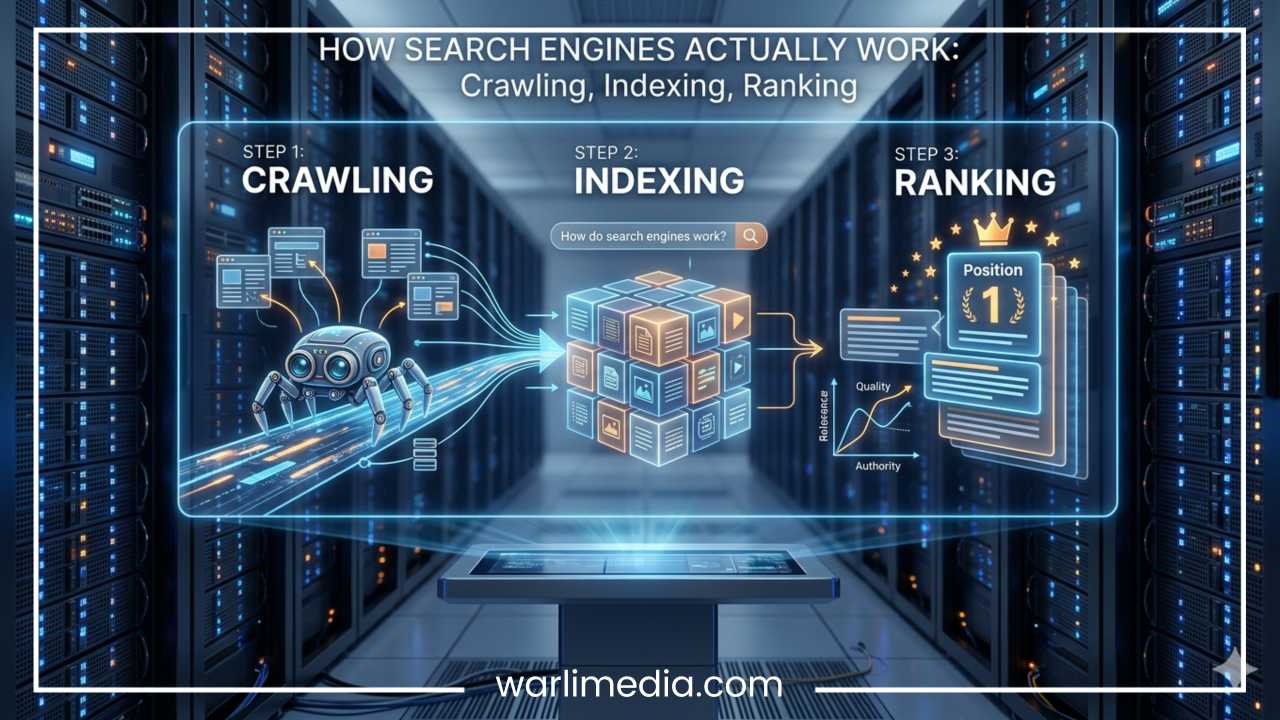
To master SEO, you must first understand how the search engines themselves operate. They are not humans; they are sophisticated software programs that “read” the internet. Their primary goal is to provide the most relevant and high-quality results to a user’s query as quickly as possible. To do this, they follow a three-step process.
Step 1: Crawling
Before a search engine can show a website, it has to know it exists. Search engines use “crawlers” (also known as bots or spiders) to find new and updated content. These bots start with a list of known web pages and follow the links on those pages to find new URLs. By hopping from link to link, the crawler discovers billions of pages across the web.
Step 2: Indexing
Once a page is discovered, the search engine tries to understand what the page is about. It analyzes the content, images, and video files on the page. This information is then stored in the Index—a massive database of all the web pages the crawler has found and deemed worthy of being shown to searchers. If your site is not in the index, it cannot appear in search results.
Step 3: Ranking
When a user types a query into the search bar, the search engine scours its index for the most relevant content. It uses complex algorithms—sets of rules and signals—to determine the order in which these pages should appear.
Key Ranking Factors:
Search Intent: Does the page answer the specific question the user asked?
Relevance: Is the content actually about the topic?
Authority: Is the website a trusted source of information?
User Experience: Is the site fast and easy to navigate?
4. Types of SEO
SEO is a broad field, but it is generally categorized into three main pillars. To achieve a high ranking, you need to pay attention to all three.
a. On-Page SEO
On-page SEO refers to the optimizations you make directly on your website pages to improve rankings. This is the area where you have the most control.
Keywords: Identifying the terms people use and placing them naturally in your text.
Title Tags and Meta Descriptions: These are the snippets of text that appear in search results. A well-written title tag tells search engines what the page is about, while a compelling meta description encourages users to click.
Header Tags (H1-H6): Using headings to structure your content helps both users and bots follow your logic.
Internal Linking: Linking to other pages on your own site helps search engines discover more of your content.
b. Off-Page SEO
Off-page SEO involves actions taken outside of your own website to impact your rankings within search engine results pages. It is primarily about building the “reputation” of your site.
Backlinks: When other reputable websites link to yours, it acts as a “vote of confidence.”
Brand Mentions: Even if a site doesn’t link to you, a mention of your brand name can signal authority to search engines.
Social Signals: While social media likes and shares aren’t a direct ranking factor, they help drive traffic and increase the likelihood of earning backlinks.
c. Technical SEO
Technical SEO refers to website and server optimizations that help search engine spiders crawl and index your site more effectively.
Site Speed: Users and search engines both prefer pages that load instantly.
Mobile-Friendliness: Most searches now happen on mobile devices, so your site must look and function perfectly on a smartphone.
XML Sitemaps: A map of your site that helps bots find all your pages.
HTTPS: Security is a priority. Using an SSL certificate (the “s” in https) is a must for modern SEO.
5. Keyword Research
Keyword research is the foundation of any SEO strategy. It is the process of finding and analyzing the actual search terms that people enter into search engines. Without keyword research, you might be creating content about topics that no one is actually looking for.
Read: How to Be an SEO Expert
Types of Keywords
Short-tail Keywords: These are broad, one or two-word terms (e.g., “shoes”). They have very high search volume but are extremely competitive and hard to rank for.
Long-tail Keywords: These are longer, more specific phrases (e.g., “best running shoes for flat feet”). They have lower search volume but are much easier to rank for and often have a higher conversion rate because the user knows exactly what they want.
Understanding Search Intent
Search intent is the “why” behind a search query. Google categorizes intent into four main types:
Informational: The user wants to learn something (e.g., “how to bake a cake”).
Navigational: The user is trying to find a specific website (e.g., “Facebook login”).
Commercial: The user is researching products but isn’t ready to buy yet (e.g., “best laptops under $1000”).
Transactional: The user is ready to buy (e.g., “buy iPhone 15 online”).
SEO Tools for Research
You don’t have to guess what people are searching for. Several tools can provide data on volume and competition:
Google Keyword Planner: Free and great for finding basic ideas.
Ahrefs: A powerful, paid tool for deep competitor analysis.
SEMrush: An all-in-one marketing suite that offers excellent keyword tracking.
6. Content & SEO
In the world of SEO, there is a common saying: “Content is King.” You can have the most technically perfect website in the world, but if your content is thin, unhelpful, or poorly written, you will not rank.
Helpful, User-Focused Content
Search engines have become incredibly smart. They can now tell if a user is satisfied with a page or if they “pogo-stick” back to the search results because the content didn’t help them. Your primary goal should be to create content that serves the user first and the search engine second.
The E-E-A-T Framework
Google uses a guideline called E-E-A-T to evaluate content quality:
Experience: Does the author have first-hand experience with the topic?
Expertise: Is the author a recognized expert or professional in this field?
Authoritativeness: Is the website a go-to source for this information?
Trustworthiness: Is the information accurate, honest, and secure?
Avoiding Keyword Stuffing
In the early days of SEO, people would cram their keywords into a page as many times as possible. This is called “keyword stuffing,” and it now results in penalties. Instead, use your keywords naturally. If you are writing about “organic gardening,” that phrase should appear where it makes sense, along with related terms like “soil,” “compost,” and “seeds.”
7. Link Building
Link building is the process of getting other websites to link to yours. These links are known as backlinks. Think of each backlink as a recommendation. If a high-authority site like The New York Times links to your blog post, Google sees that as a massive signal that your content is trustworthy.
Why Backlinks Matter
Backlinks are one of the top three ranking factors for Google. They help build “Domain Authority,” which essentially tells the search engine how much power your website has compared to others in your niche.
Beginner Strategies for Link Building
Guest Posting: Writing an article for another website in your industry in exchange for a link back to your site.
Directory Submissions: Adding your business to reputable local or industry-specific directories.
Creating Shareable Content: Infographics, original research, and “ultimate guides” are naturally more likely to be linked to by others.
The Skyscraper Technique: Find a popular piece of content in your niche, create something significantly better, and reach out to people who linked to the original to suggest they link to yours instead.
8. Technical SEO Basics
Technical SEO ensures that your website provides a smooth experience for both users and search engine bots. If your site is a house, technical SEO is the foundation and the plumbing.
Page Speed and Core Web Vitals
Google uses a set of metrics called Core Web Vitals to measure how users experience the speed, responsiveness, and visual stability of a page. If your site takes more than 3 seconds to load, a large percentage of users will leave before they even see your content. You can improve speed by compressing images and using a fast hosting provider.
Mobile Optimization
Over 60% of global search traffic comes from mobile devices. Google now uses “mobile-first indexing,” meaning it looks at the mobile version of your site to determine rankings, even for desktop searches. Your site must be responsive, meaning it automatically adjusts its layout for any screen size.
Security (HTTPS)
Security is a non-negotiable ranking factor. Sites using HTTPS (Hypertext Transfer Protocol Secure) are favored over those using HTTP. This protects user data and builds trust.
Fixing Broken Links
A broken link (a 404 error) is a dead end for a crawler and a frustrating experience for a user. Regularly auditing your site to find and fix these links is a crucial part of technical maintenance.
9. SEO Tools for Beginners
Managing SEO manually is nearly impossible. Fortunately, there are several tools—many of them free—that can help you track your progress.
Google Search Console: This is a must-have. It tells you exactly how Google sees your site, which keywords you are ranking for, and if there are any technical errors preventing your pages from being indexed.
Google Analytics: While Search Console tells you how people find your site, Google Analytics tells you what they do once they arrive. It tracks user behavior, bounce rates, and conversions.
Ubersuggest: Created by Neil Patel, this tool is very beginner-friendly. It provides keyword suggestions, site audits, and competitor data in an easy-to-read format.
Yoast SEO (for WordPress): If you use WordPress, this plugin is a lifesaver. It provides a simple “stoplight” system (red, orange, green) to show you how well your individual posts are optimized for your target keywords.
10. Common SEO Mistakes to Avoid
Even seasoned professionals make mistakes, but as a beginner, avoiding these common pitfalls will put you ahead of the competition.
Keyword Stuffing: We mentioned this before, but it bears repeating. Writing for bots instead of humans will result in a poor user experience and lower rankings.
Ignoring Mobile Users: Designing only for desktop is a recipe for failure in the modern web landscape.
Duplicate Content: Search engines get confused when they find the exact same text on multiple pages or different websites. Always strive for original content.
Buying Backlinks: It can be tempting to buy 1,000 links for $10 on a random website. Don’t do it. These are “spammy” links that will likely get your site penalized or even banned from search results.
Not Updating Content: SEO is not a “set it and forget it” task. Information changes, and search engines love “fresh” content. Revisit your old posts once or twice a year to ensure they are still accurate.
11. How Long Does SEO Take?
One of the most common questions beginners ask is: “When will I see results?”
It is important to understand that SEO is a long-term strategy. Unlike paid ads, which can drive traffic the moment you start paying, SEO takes time to build momentum.
Typically, it takes anywhere from 3 to 6 months to start seeing significant movement in your rankings. This timeline depends on several factors:
The age of your domain (newer sites take longer to build trust).
The level of competition for your keywords.
The quality and frequency of your content updates.
The consistency of your link-building efforts.
Patience is key. SEO is a marathon, not a sprint, but the rewards are far more sustainable than any short-term marketing tactic.
12. Future of SEO
The world of search is constantly evolving. While the fundamentals of relevance and authority remain the same, the technology used to find information is shifting.
AI and Search: Search engines are increasingly using Artificial Intelligence (like Google’s Gemini and SGE) to provide direct answers to queries. This means your content needs to be even more comprehensive and authoritative to be cited as a source.
Voice Search: With the rise of smart speakers and virtual assistants, more people are searching using natural speech. This makes long-tail, conversational keywords more important than ever.
Focus on User Experience (UX): Search engines are moving toward a “holistic” view of a website. It’s no longer just about the text; it’s about how easy it is for a human to accomplish their goal on your site.
Final Thoughts
SEO can seem overwhelming when you first start, but it is ultimately about one simple goal: providing the best possible answer to a user’s question. By focusing on high-quality content, a solid technical foundation, and building a reputable brand, you can climb the search engine rankings and grow your audience.
The most important thing you can do right now is start. You don’t need to be an expert to make an impact. Begin by identifying five keywords your audience might use, write a helpful article for each, and ensure your website loads quickly on a phone.
SEO is an ongoing journey of learning and refining. Stay curious, stay consistent, and over time, you will see your hard work reflected in the search results. Start optimizing today, and give your website the visibility it deserves.