Meta Descriptions: Do They Still Matter for Ranking?
In the rapidly evolving landscape of Search Engine Optimization (SEO), few elements have sparked as much perennial debate as the meta description. As search engines become more sophisticated—utilizing machine learning, natural language processing, and advanced neural networks—the traditional “checklist” of SEO tasks is frequently under scrutiny. Digital marketers and business owners often find themselves asking: is it still worth spending time crafting the perfect 160-character snippet, or has the era of automated search results made this practice obsolete?
To understand the relevance of meta descriptions today, we must first define what they are: short snippets of HTML code that summarize a page’s content. They serve as the “elevator pitch” for your website within the search engine results pages (SERPs). While the technical framework of the web has changed, the human psychology behind why people click one link over another has remained remarkably consistent.
Read: Off-Page SEO Optimization Techniques
The short answer to the question of relevance is nuanced. Meta descriptions do not directly impact rankings. If you include a specific keyword in your description, Google will not move your site from position ten to position one based on that inclusion alone. However, meta descriptions strongly influence click-through rate (CTR). Because CTR is a vital metric for driving traffic and potentially signaling content relevance to search engines, the meta description remains a cornerstone of a high-performance SEO strategy. This article explores the technical reality, the indirect benefits, and the modern best practices for managing these critical snippets.
What Are Meta Descriptions?
A meta description is an HTML attribute that provides a concise summary of a web page. In the source code, it appears as a tag within the <head> section: <meta name="description" content="A brief summary of the page content goes here.">.
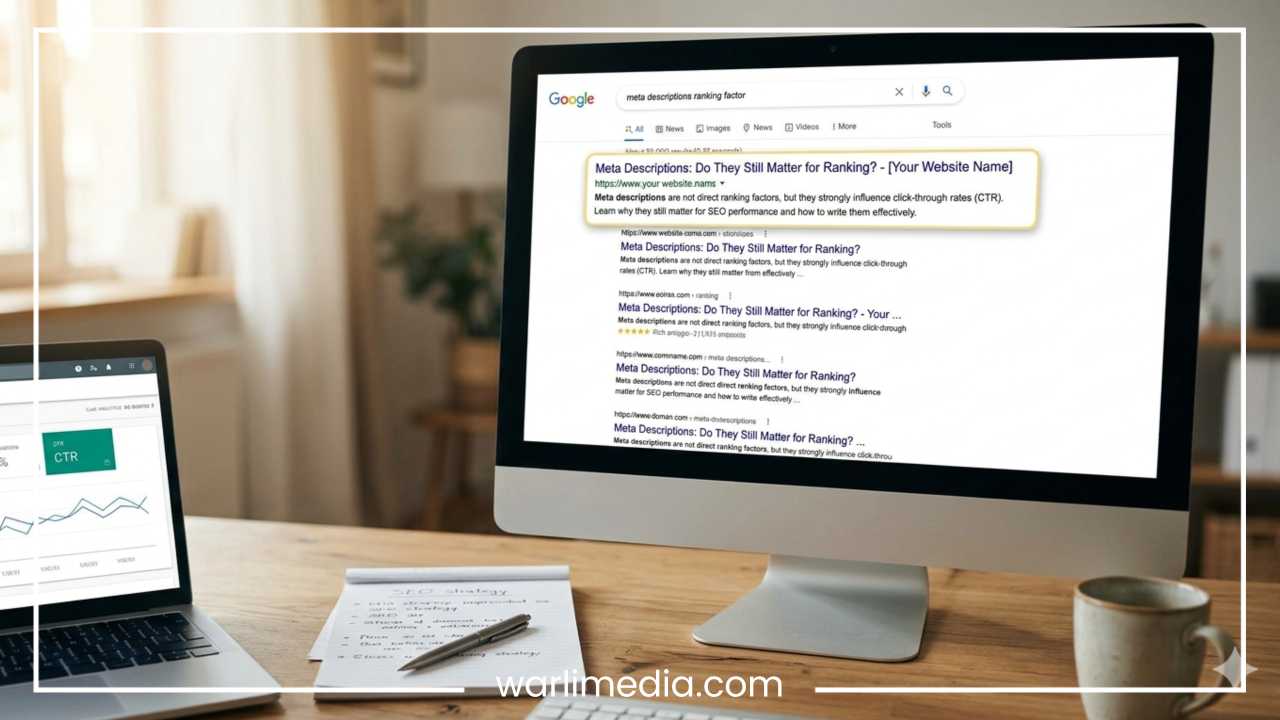
While invisible to the user browsing the actual page, this snippet is primary data for search engines. When a user performs a search, the search engine typically displays a “snippet” representing each result. This snippet is composed of three main parts:
The Title Tag: The clickable headline, usually in blue.
The URL/Breadcrumb: The web address or path to the page.
The Meta Description: The two to three lines of descriptive text below the title.
The primary purpose of this description is to inform the user exactly what they will find if they click the link. It serves as a bridge between the user’s query and your content.
Read: How to SEO Optimize Your New Website For Search Engines
Character Limits and Display
Search engines do not have a “hard” character limit, but they do have a pixel limit. Generally, desktop results accommodate more text than mobile results. For practical purposes, SEOs aim for 155 to 160 characters.
Desktop: Usually displays up to 920 pixels, which translates to roughly 160 characters.
Mobile: Displays slightly less, often cutting off around 120 characters depending on the device.
If a description is too long, it will be truncated with an ellipsis (…), which can cut off your call to action or crucial information. If it is too short, you are wasting valuable “real estate” on the SERP that could be used to persuade the user.
Do Meta Descriptions Affect Rankings?
There is a common misconception that stuffing keywords into a meta description will help a page rank higher for those terms. To be perfectly clear: Google has confirmed that meta descriptions are not a direct ranking factor.
This was officially stated as far back as September 2009, when Google’s Webmaster Central Blog published a post titled “Google does not use the keywords meta tag in web ranking.” Within that clarification, they specified that neither meta keywords nor meta descriptions are used in their primary ranking algorithms for web search.
Read: Local SEO Services And Their Advantages
Ranking Factors vs. Performance Signals
It is essential to distinguish between a direct ranking factor and an indirect influence.
Direct Ranking Factors: These are elements like backlinks, content quality, page speed, and mobile-friendliness. Google’s algorithm looks at these to determine the “authority” and “relevance” of a page.
Indirect Influence: This involves how users interact with your result. If your meta description is so compelling that it earns a 10% click-through rate while the result above you only gets 5%, you are effectively capturing more market share.
Some SEO professionals argue that a consistently high CTR acts as a signal to search engines that your page is a highly relevant result for that specific query, which may eventually lead to a ranking boost. While Google has been cagey about whether “user signals” like CTR are used to adjust rankings in real-time, the outcome for the business is the same: more clicks equal more value.
The Indirect SEO Value of Meta Descriptions
Even though the “bots” might ignore your meta description when calculating your position, the human beings searching for information do not. The indirect value of a well-written description can be categorized into four main areas.
Click-Through Rate (CTR)
Think of your meta description as your organic search “ad copy.” In a world where everyone is fighting for attention, a description that highlights a unique selling point—like “Free Shipping,” “Verified Experts,” or “Step-by-Step Guide”—will almost always outperform a generic, auto-generated snippet. Increasing your CTR is the fastest way to increase traffic without actually moving up in the rankings.
User Intent Alignment
A high ranking is useless if the user clicks your link and immediately realizes the page isn’t what they were looking for. A clear meta description sets accurate expectations. By aligning the snippet with the user’s intent (informational, transactional, etc.), you ensure that the people clicking through are actually interested in what you have to offer.
Bounce Rate Considerations
While the relationship between bounce rate and SEO is a topic of debate, there is no doubt that “pogo-sticking” (when a user clicks a result and immediately hits the back button) is a sign of a poor user experience. An accurate meta description prevents this by filtering out users who aren’t a good fit for the content, leading to longer dwell times and better engagement for those who do stay.
Brand Perception
The SERP is often the first interaction a potential customer has with your brand. A professional, well-formatted, and helpful meta description builds trust. Conversely, a description that is cut off mid-sentence or filled with broken code and typos makes a brand look neglected and amateur.
When Google Ignores Your Meta Description
One of the most frustrating experiences for an SEO is spending hours writing custom meta descriptions, only to find that Google has replaced them with a different snippet of text.
Research suggests that Google rewrites meta descriptions over 70% of the time. This is not a bug; it is a feature designed to provide the most relevant answer to the user’s specific query. There are three primary reasons why this happens:
Query Mismatch: If a user searches for a specific long-tail keyword that is on your page but not in your meta description, Google will pull a “bolded” snippet of text from your body copy that contains that keyword to show the user the page is relevant.
Low-Quality or Generic Content: If your meta description is “Welcome to our website,” Google will almost certainly ignore it in favor of something more descriptive from the page.
Keyword Stuffing: If you attempt to manipulate the system by listing keywords like “best shoes, cheap shoes, buy shoes online,” Google’s algorithms will likely flag it as spammy and replace it with a more readable sentence from your content.
To minimize the chances of a rewrite, your description must be highly relevant to the primary topic of the page and written in a way that provides a better summary than a randomly selected sentence from the body text.
How to Write High-Performing Meta Descriptions
Writing a great meta description is a blend of data-driven SEO and creative copywriting. To maximize your impact, follow these six actionable guidelines.
1. Match Search Intent
Before writing a single word, ask yourself: What is the user trying to achieve?
Informational: The user wants to learn. Use words like “How to,” “Guide,” or “Explanation.”
Transactional: The user wants to buy. Use words like “Shop,” “Discount,” or “Best Price.”
Navigational: The user is looking for a specific brand or login page. Keep it concise and brand-focused.
2. Use Primary Keywords Naturally
While keywords don’t help you rank via the description, Google bolds words in the description that match the user’s search query. This bolding is a powerful visual cue that draws the user’s eye and signals that your page has exactly what they are looking for.
3. Add a Clear Value Proposition
Why should someone click your link instead of the nine others on the page? Do you offer a free trial? Is your article based on a decade of research? Does your product have a lifetime warranty? Put your strongest asset front and center.
4. Include a Call-to-Action (CTA)
Organic search is still a sales funnel. Use active verbs to prompt a response.
“Download our free template.”
“Read our full analysis.”
“Start your journey today.”
5. Keep It Within Optimal Length
Aim for the “sweet spot” of 140 to 155 characters. This ensures that your most important information is visible on both mobile and desktop devices without being prematurely truncated.
6. Make It Unique for Every Page
Duplicate meta descriptions are a missed opportunity. Every page on your site exists for a different reason; therefore, every page should have a unique description. If you have thousands of pages (like an eCommerce site), use templates to pull in specific data like product names and prices to maintain uniqueness.
Meta Descriptions for Different Page Types
The strategy for a blog post is vastly different from the strategy for a product page.
Blog Posts
For editorial content, the goal is to pique curiosity or promise a solution.
Example: “Struggling to get your sourdough to rise? Follow our 5-step guide to mastering the perfect crust and crumb, even if you are a total beginner.”
Product Pages (eCommerce)
Focus on specifications, benefits, and purchase triggers.
Example: “Buy the XYZ 3000 Running Shoes. Lightweight, waterproof, and designed for trail running. Free 2-day shipping on all orders over $50.”
Landing Pages
Landing pages are high-conversion areas. The meta description should be laser-focused on the primary offer.
Example: “Join over 10,000 professionals who use our SEO toolkit to automate their reporting. Sign up for a free 14-day trial today.”
Category Pages
Category pages should describe the breadth of the selection.
Example: “Browse our full collection of ergonomic office chairs. From mesh backs to executive leather, find the perfect chair for your home office at unbeatable prices.”
Common Mistakes to Avoid
Even seasoned marketers fall into traps that render their meta descriptions ineffective.
Duplicate Descriptions: Having the same description for 50 different pages confuses both search engines and users. It makes your site look like it has “thin” or repetitive content.
Being Too Vague: Avoid phrases like “Click here for more info.” It tells the user nothing and provides no incentive.
Keyword Stuffing: This is a relic of the late 90s. It makes your brand look like a spam bot and will almost certainly lead to Google rewriting your snippet.
Ignoring Branding: If your brand has a specific voice—be it witty, professional, or minimalist—ensure that voice is reflected in your descriptions.
Writing for Bots: Remember that a human is the one making the decision to click. Use natural language, correct grammar, and a persuasive tone.
Meta Descriptions vs. Other SERP Elements
In the modern SERP environment, the meta description is just one part of a larger ecosystem of features. Understanding where it fits is key to a holistic strategy.
Title Tags: These remain a direct ranking factor. While the description is the “body” of your ad, the title is the “headline.” They must work in tandem.
Rich Snippets: These include extra information like star ratings, prices, and availability, pulled from Schema markup. Rich snippets often appear alongside the meta description, making the result even more prominent.
Featured Snippets: This is the “Position Zero” result that answers a question directly on the SERP. If you win a featured snippet, your custom meta description is usually ignored in favor of the content that answers the query.
Schema Markup: While not visible as a “description,” Schema helps search engines understand the context of your data, which can indirectly lead to more relevant snippet generation.
Are Meta Descriptions Worth Your Time?
Given that Google rewrites them so often and they don’t directly affect rankings, are they still worth the effort?
The answer is a resounding yes.
Meta descriptions are high-ROI (Return on Investment) tasks because they directly impact the “middle of the funnel.” You have already done the hard work of ranking on page one. The meta description is what ensures that the ranking actually turns into a visitor.
For large websites, prioritize your efforts:
High-Impression Pages: Focus on the pages that already appear in search results frequently.
Commercial Keywords: Focus on pages where a click has a high monetary value.
Home Page: This is your primary brand representation.
Final Thoughts
In the world of SEO, it is easy to get distracted by the latest “hacks” or complex algorithm updates. However, the basics often provide the most consistent value. Meta descriptions are a prime example of a fundamental element that has transitioned from a technical ranking signal to a sophisticated marketing tool.
To summarize:
They are not a ranking factor: Keywords in your description won’t move your position.
They are a CTR factor: A great description earns more clicks than a mediocre one.
They are brand representatives: Your snippet is your first impression.
Think of meta descriptions as ad copy for organic search. By treating every search result as a mini-advertisement, you can drive more traffic, better satisfy user intent, and build a more trustworthy brand presence on the web. Regardless of how much search engines change, providing a clear, compelling reason for a user to click will always be a winning strategy.