Why SEO Is Still the Best Way to Grow a Website
The digital landscape is a crowded, noisy, and rapidly shifting environment. Every day, a new platform emerges, a new algorithm dictates what we see, and a new “expert” declares that the old ways of marketing are obsolete. We have seen the explosion of social media giants like TikTok and Instagram, the rise of influencer marketing, and the disruptive entry of generative AI into our daily workflows. Amidst this whirlwind of change, a familiar refrain often echoes through the halls of digital marketing: “SEO is dead.”
This claim is usually followed by a push toward the latest shiny object—be it high-spend paid advertising or viral short-form video. However, the data and the reality of user behavior tell a different story. Search Engine Optimization (SEO) is not only alive; it remains the most sustainable, scalable, and cost-effective way to grow a website.
Read: Understanding Google Panda: How it Changed SEO Forever
The fundamental reason for this is human psychology. As long as people have questions, needs, or problems, they will turn to search engines to find solutions. Whether they are typing a query into a browser or asking a voice assistant, the act of searching represents a specific intent that social media “discovery” simply cannot replicate. This article will argue that while the tactics of SEO have evolved, its core value as the ultimate growth engine for digital presence remains unmatched. By focusing on intent, compounding value, and authority, SEO provides a foundation that no other marketing channel can offer.
The Myth: “SEO Is Dead”
The declaration that SEO has met its demise is almost as old as Google itself. These claims usually peak during significant industry shifts. For instance, whenever Google releases a major algorithm update—such as the broad core updates that reshuffle rankings—critics argue that the game is now “rigged” or too difficult to play.
More recently, the rise of AI tools like ChatGPT and Google’s own Search Generative Experience (SGE) has sparked fears that users will no longer click through to websites. The logic is that if an AI can summarize an answer, the website providing the source material becomes irrelevant. Simultaneously, the dominance of social media platforms has led some to believe that “discovery” has moved entirely to the feed. Why search for a product when an algorithm can put it in front of you while you scroll?
Read: How to Improve SEO of Your Website
However, these objections overlook the nuances of how the internet works. Search demand is actually growing, not shrinking. As more of the global population gains high-speed internet access and more of our daily lives move online, the volume of queries continues to rise. Furthermore, social media platforms are increasingly becoming search engines themselves—TikTok is used by younger generations to search for reviews and tutorials, which is effectively a form of SEO.
The reality is that SEO has evolved, not disappeared. The days of “keyword stuffing” and low-quality link schemes are long gone. In their place is a more sophisticated discipline that rewards genuine value. Businesses still rely heavily on organic traffic because it represents a stable, recurring source of leads that does not disappear the moment a daily ad budget is exhausted.
What SEO Really Means Today
To understand why SEO remains the king of growth, we must first define what it looks like in the modern era. It is no longer just about ranking for a specific word; it is about providing the best possible answer to a user’s query. Modern SEO is a multi-dimensional discipline that encompasses technical health, user experience, and content depth.
Technical SEO
This is the “under the hood” work. It ensures that search engine crawlers can easily access, index, and understand your site. This includes site speed, mobile-friendliness, secure connections (HTTPS), and structured data (schema). If your site is slow or broken, no amount of great content will save your rankings.
On-Page SEO
This involves optimizing individual pages. While keywords are still important, the focus has shifted toward search intent. Does the page actually give the user what they were looking for? This includes optimizing titles, headers, and meta descriptions to improve click-through rates and engagement.
Content Strategy
Content is the vehicle for SEO. Today’s strategy involves building “topic clusters”—groups of related content that demonstrate a deep understanding of a subject. This move away from isolated blog posts toward comprehensive resources helps search engines see your site as a topical authority.
E-E-A-T (Experience, Expertise, Authoritativeness, and Trustworthiness)
Google’s quality evaluator guidelines emphasize E-E-A-T. To grow a website today, you must prove that you are a credible source. This means showing real-world experience, citing expert authors, and building a brand that users and other websites trust. SEO is now as much about brand building as it is about technical optimization.
Read: How to Earn Backlinks for Your Website
SEO vs. Paid Ads: Long-Term ROI
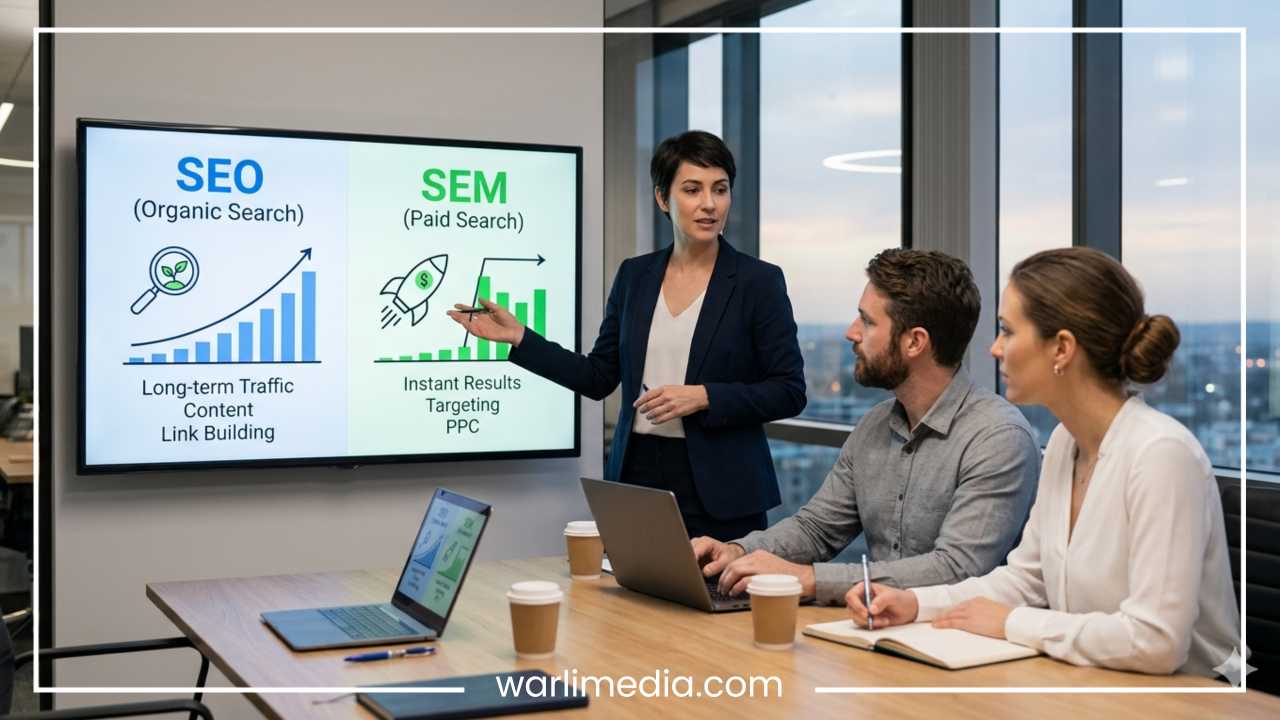
One of the most common debates in digital growth is whether to invest in SEO or Paid Advertising (PPC). While paid ads offer immediate gratification, SEO offers a superior Long-Term Return on Investment (ROI).
The “Faucet” Problem
Paid advertising is like a water faucet. As long as you pour money into Google Ads or Meta Ads, the traffic flows. The moment you stop paying, the traffic disappears instantly. This creates a dependency where your growth is directly tied to your ability to keep spending. In many industries, the Cost Per Click (CPC) is rising every year, making it harder for small to medium-sized businesses to maintain profitability.
The Compounding Nature of SEO
SEO, by contrast, is an investment in an asset. When you spend time or money creating an optimized, high-quality article, that article stays on the internet indefinitely. Over time, it gains backlinks and authority, often resulting in an increase in traffic rather than a decrease.
Consider a scenario where a company spends $5,000 on a month-long ad campaign. They might get a surge of 2,000 visitors. Once the $5,000 is gone, the visitors stop. If that same company spends $5,000 on high-quality SEO content and technical fixes, those assets might bring in 500 visitors in the first month, 1,000 in the third month, and 5,000 every month a year later—all without additional spend for those specific visitors. The Cost Per Acquisition (CPA) in SEO tends to trend downward over time, whereas in paid ads, it often trends upward due to competition.
Compounding Growth Effect of SEO
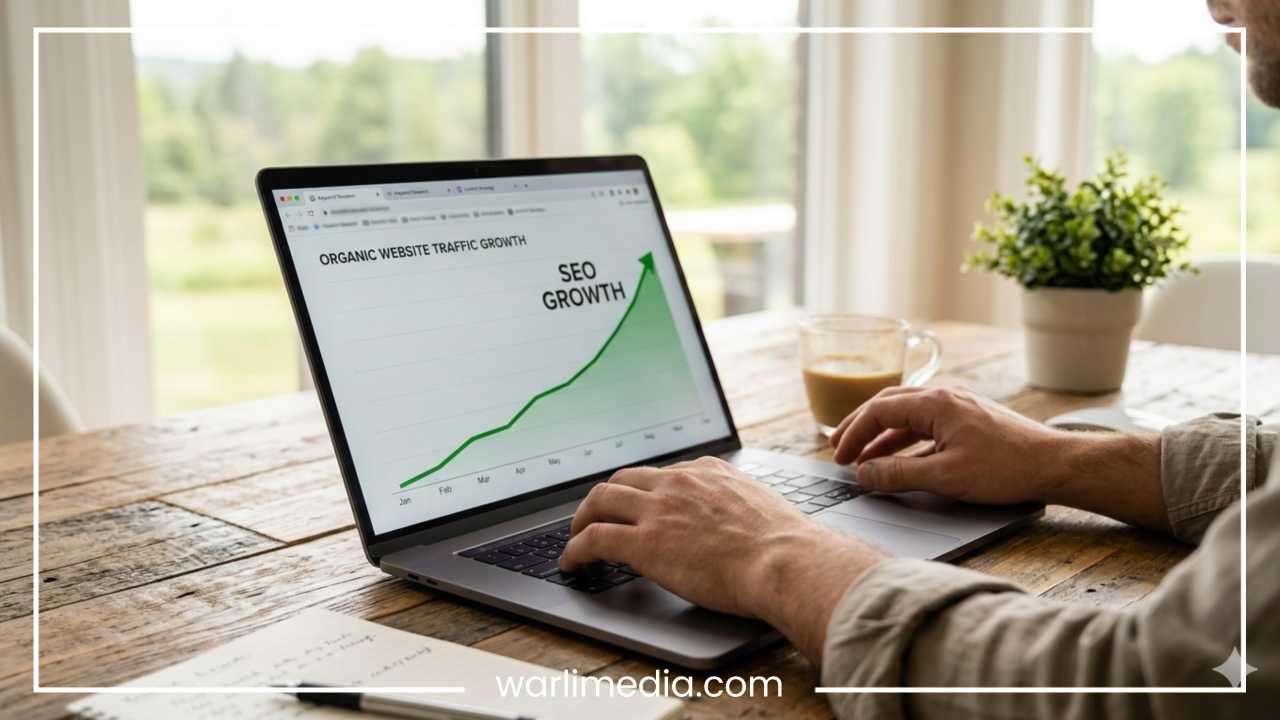
The most powerful aspect of SEO is its ability to compound. In finance, compounding interest allows a small amount of money to grow exponentially over time. In SEO, “content stacking” works the same way.
When you first start a website, growth is slow. You publish an article, and it might get ten visits a month. However, as you add more content, you create a web of internal links. This internal linking structure passes “authority” from your successful pages to your newer pages.
The Growth Loop
As your site grows from 10 pages to 100 pages, and eventually to 1,000 pages, you aren’t just adding traffic linearly. You are building a massive footprint that captures thousands of “long-tail” keywords—specific, multi-word phrases that are less competitive but highly relevant.
A single well-written guide can continue to drive traffic for five years or more with only minor updates. When you have hundreds of these assets working for you simultaneously, the result is a growth curve that moves from a flat line to a steep upward trajectory. This scalability is something that social media marketing, which requires a constant “treadmill” of new posts to stay relevant, cannot match.
High-Intent Traffic = Better Conversions
Not all traffic is created equal. You could have a viral video on social media that reaches a million people, but if those people were just looking for entertainment, they are unlikely to buy your product or sign up for your newsletter. This is “interruption marketing.” You are interrupting their scroll with an ad or a post.
The Power of Search Intent
SEO provides “inbound” traffic based on intent. When someone types “best lightweight hiking boots” into a search engine, they have already identified a need. They are actively looking for information or a product. They are at the “consideration” or “decision” stage of the buyer’s journey.
Because these users are actively seeking a solution, they convert at a much higher rate than users who stumble upon your brand via a social media feed. SEO allows you to position your website as the answer to the user’s specific problem at the exact moment they are thinking about it. This alignment of intent and solution is why organic search traffic is often the highest-converting channel for e-commerce and B2B businesses alike.
SEO Builds Brand Authority & Trust
In the digital world, visibility is often equated with credibility. If a user searches for a term related to your industry and your website consistently appears in the top three results, they subconsciously begin to view you as a leader in that field.
Organic vs. Paid Trust
Studies consistently show that users tend to trust organic search results more than paid advertisements. Many savvy internet users have “ad blindness”—they instinctively skip over the sponsored results at the top to find the “real” answers below. By ranking organically, you are benefiting from the search engine’s “endorsement.” The algorithm has determined that your site is the most relevant and trustworthy answer, and users respect that.
Furthermore, SEO allows for “thought leadership.” By creating comprehensive guides, white papers, and insightful blog posts, you aren’t just selling; you are educating. This builds a layer of trust that makes the eventual sale much easier. When a customer feels that a brand has helped them understand a problem, they are far more likely to remain loyal to that brand.
SEO Supports Every Stage of the Funnel
A common mistake is thinking that SEO is only for top-of-funnel awareness. In reality, a robust SEO strategy supports the entire customer journey.
Awareness (Top of Funnel)
At this stage, users are looking for general information. They might search for “how to grow vegetables” or “why is my laptop slow.” By providing educational blog content, you introduce your brand to them early on.
Consideration (Middle of Funnel)
Here, the user knows their problem and is looking for specific solutions. They might search for “organic vs. chemical fertilizers” or “best laptop repair services in Seattle.” Comparison guides and “how-to” articles are perfect for this stage.
Decision (Bottom of Funnel)
At the final stage, the user is ready to buy. They search for “buy organic tomato seeds” or “coupon code for [Brand Name].” Product pages, landing pages, and reviews are optimized for these high-intent keywords to close the sale.
By covering all these stages, SEO ensures that you are with the customer every step of the way, rather than just shouting at them when they are ready to buy.
SEO Works 24/7: The Passive Growth Engine
One of the most attractive features of SEO is that it is a “set it and forget it” (to an extent) growth engine. Unlike a physical store that has opening hours, or a sales team that needs sleep, your website is accessible to the world 24 hours a day, 365 days a year.
Automated Growth
An optimized website is essentially an automated salesperson. Someone in a different time zone can find your article at 3:00 AM, read your advice, and click your affiliate link or buy your product. You don’t have to be present for the transaction to occur.
While SEO does require ongoing maintenance and updates, the “evergreen” nature of high-quality content means that your past work continues to pay dividends. This allows business owners to focus on other areas of growth, knowing that their organic traffic will continue to hum along in the background.
SEO Adapts to New Trends
One of the reasons people think SEO is dying is because it is changing. But adaptation is a sign of strength, not weakness. SEO has proven remarkably resilient in the face of new technology.
AI and Generative Search
While AI search tools provide direct answers, they also cite sources. SEO is now shifting toward “Generative Engine Optimization,” where the goal is to be the authoritative source that the AI references. If you provide the most data-rich, unique, and insightful content, AI models will continue to point users toward your site for deeper dives.
Voice Search and Mobile
With the rise of smart speakers and mobile usage, search queries have become more conversational. SEO has adapted by focusing on natural language processing and “Featured Snippets”—those boxes at the top of Google results that answer a question directly.
Video SEO
YouTube is the second largest search engine in the world. SEO principles—keywords, descriptions, and user engagement—apply there just as much as they do on Google. A modern SEO strategy often includes video, ensuring that a brand occupies as much “search real estate” as possible across different platforms.
Challenges of SEO (Be Honest)
To say SEO is perfect would be a disservice. It is a difficult, long-term play that requires patience and discipline. It is important to acknowledge the hurdles to understand why it remains a competitive advantage for those who stick with it.
The Time Factor
SEO is not an overnight success story. It typically takes 3 to 6 months to start seeing significant results from a new campaign, and even longer in highly competitive niches. This delay is why many businesses quit and go back to paid ads. However, this barrier to entry is exactly what makes SEO so valuable—once you have achieved a high ranking, it is equally difficult for a competitor to unseat you quickly.
Consistency and Effort
You cannot “do SEO” once and be done. It requires a consistent output of high-quality content and regular technical audits. The internet is always moving, and if you stop improving, your competitors will eventually pass you.
Algorithm Uncertainty
Google is famous for its “black box” algorithm. No one knows exactly how it works, and a single update can sometimes cause a temporary dip in traffic. This requires a mindset of resilience and a focus on long-term quality over short-term “hacks.”
When SEO Might NOT Be the Best Strategy
Despite its power, SEO is not always the right move for every situation. It is important to be realistic about its limitations.
New Product Launches: If you have a brand-new, revolutionary product that no one is searching for yet, you cannot rely on SEO to drive initial awareness. In this case, social media and paid ads are better for “creating” demand.
Time-Sensitive Campaigns: If you are running a sale for 48 hours, SEO will not help you. You need the immediate reach of email marketing or PPC.
Highly Competitive Niches with Zero Resources: If you are a solo blogger trying to outrank massive corporations for a term like “life insurance” without a significant budget or a unique angle, you are likely to be disappointed.
In these cases, SEO should be a secondary goal while more immediate channels handle the heavy lifting.
How to Start Winning with SEO Today
If you are convinced that SEO is the path to growth, the next step is action. You don’t need a massive agency to start; you just need a logical framework.
1. Keyword Research
Start by understanding what your audience is actually typing into search bars. Use tools to find “low-hanging fruit”—keywords with decent volume but low competition. Focus on “long-tail” keywords that reflect specific problems you can solve.
2. Create High-Quality Content
Do not write for robots; write for humans. Your content should be the most helpful resource on the internet for that specific topic. Use clear headings, bullet points, and images to make it readable.
3. Optimize On-Page SEO
Ensure your target keyword is in the title, the first paragraph, and the meta description. But more importantly, ensure the page loads quickly and looks great on a mobile phone.
4. Build Backlinks
A backlink is a “vote of confidence” from another website. You get these by creating “linkable assets”—original research, infographics, or truly unique perspectives that other people want to reference.
5. Improve User Experience (UX)
Google monitors how users interact with your site. If people click your link and immediately hit the “back” button (bouncing), it tells Google your page wasn’t helpful. Focus on keeping people on your site by providing internal links to other relevant articles.
6. Track and Iterate
Use free tools like Google Analytics and Google Search Console. See which pages are performing well and which are lagging. SEO is a process of constant refinement.
Final Thoughts
The digital world will continue to change. New platforms will rise, and old ones will fade. But as long as the internet exists, people will use it to find answers. SEO is the art and science of being that answer.
It is not a “hack” or a “trick.” It is a commitment to building a high-quality, authoritative, and user-friendly digital presence. Unlike paid advertising, which is a temporary rental of attention, SEO is the construction of a digital empire. It is the only channel that compounds in value, builds deep-seated trust with your audience, and scales sustainably over the long term.
If you are looking for a quick fix, look elsewhere. But if you want to grow a website that lasts, that survives algorithm shifts, and that continues to bring in customers while you sleep, SEO is still—and will remain—the best way to grow. It is not dead; it is simply maturing, rewarding those who prioritize value over shortcuts. In the race for digital growth, the slow and steady compounding of organic search remains the ultimate winner.