
The Future of Search: Predictions for the Next 5 Years
The Evolution of Search
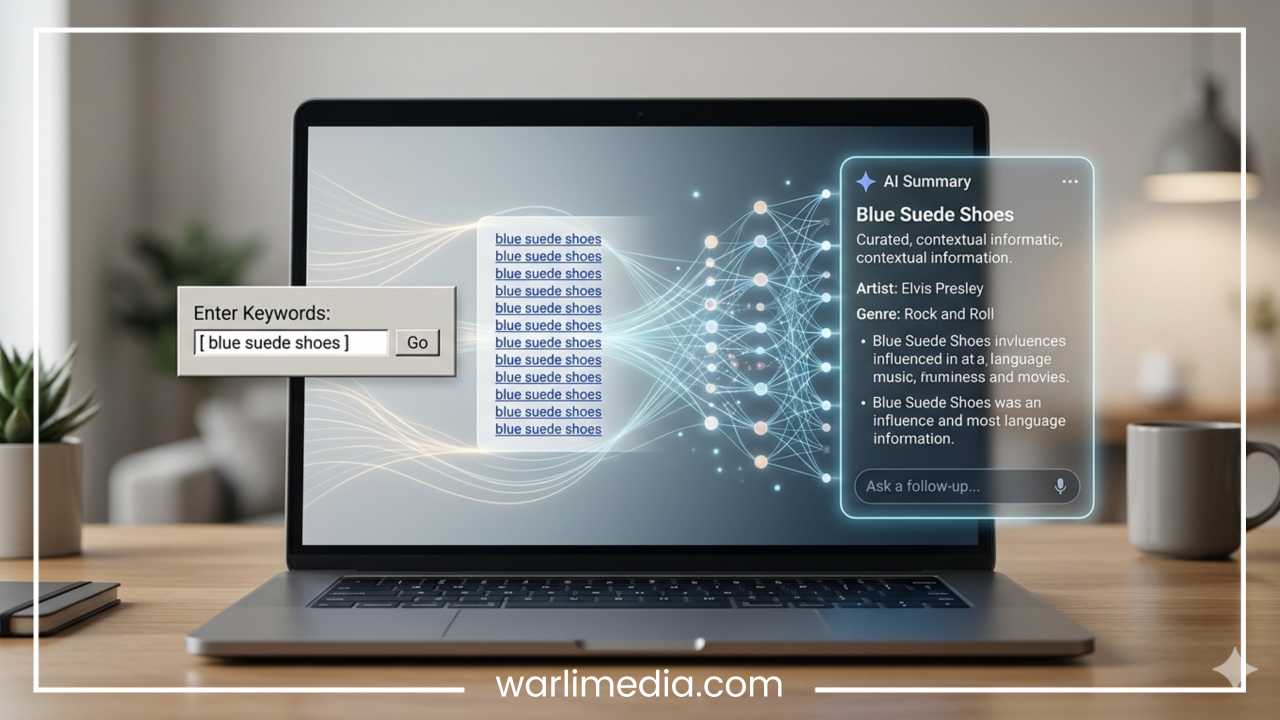
For the better part of three decades, the act of “searching” has been synonymous with typing fragmented keywords into a rectangular box and scanning a list of blue links. This era, defined by the indexing of the web and the hierarchy of PageRank, transformed the internet from a chaotic digital library into a navigable utility. However, we are currently witnessing the most radical shift in the history of information retrieval. We are moving away from a world of keyword matching and toward a world of cognitive understanding.
The evolution of search can be charted through three distinct phases. The first was the Keyword Era, where search engines acted as simple indexes, matching strings of text regardless of their meaning. The second was the Semantic Era, where algorithms began to understand entities, relationships, and the intent behind a query. Today, we have entered the AI-Driven Era, where search engines no longer just find information—they synthesize it.
Read: How Should You Classify Your Business Blog?
As we look toward the next five years, search is at a critical turning point. The convergence of generative artificial intelligence, multimodal processing, and hyper-personalization is fundamentally altering the “search” verb. We are transitioning from a transactional relationship with search engines to a relational one. The future of search is not a destination or a specific website; it is an invisible, conversational, and predictive layer that integrates seamlessly into our daily lives.
AI-Powered Search Will Become the Default
The most immediate and profound transformation is the rise of the “Answer Engine.” For decades, search engines were conduits, pointing users toward third-party websites where answers resided. In the coming five years, the primary function of search will shift from curation to synthesis. Generative AI models are now capable of reading across dozens of sources, extracting relevant facts, and presenting a coherent, unified response directly on the search results page.
From Links to Answers
The traditional Search Engine Results Page (SERP) is a list of possibilities. The future interface is a Generative Experience. When a user asks a complex question, the engine will no longer provide ten blue links for the user to research. Instead, it will produce a bespoke report. If you search for “The best itinerary for a five-day sustainable trip to Japan,” you won’t get a travel blog; you will get a generated document that cross-references train schedules, eco-friendly hotel ratings, and local weather forecasts.
Will Users Still Click?
The “click” has been the currency of the internet for a generation. As search engines evolve into answer engines, the “zero-click” phenomenon will expand from simple facts (like the height of the Eiffel Tower) to complex reasoning. This creates a tension between the platform and the publisher. If the search engine provides 90 percent of the value on the page, the user has little incentive to visit the source. However, users will still seek the “source of truth” for high-stakes decisions—legal advice, medical diagnoses, or deep investigative journalism. The role of the link will shift from “finding information” to “verifying information.”
Read: Positive Qualities for a Business Blog
Conversational and Voice Search Will Surge
The interface of search is migrating from the keyboard to the natural voice. While voice search has existed for years through early smart speakers, it has historically been limited to simple commands. The next five years will see voice search mature into true conversational search.
Context-Aware Multi-Turn Queries
The limitation of early voice search was its “amnesia.” Every query was a fresh start. Future search engines, powered by Large Language Models (LLMs), will maintain persistent context. You can ask, “Who won the World Series in 1986?” and follow up with, “Was it a close series?” The engine understands “it” refers to the 1986 World Series. This allows for a “Socratic” search experience where the user and the AI narrow down a topic through dialogue.
The Hands-Free Revolution
This surge will be driven by the ubiquity of connected environments. In the automotive sector, search will become a sophisticated co-pilot. Instead of fumbling with a GPS, a driver will simply say, “Find a coffee shop on my route that has a drive-thru, high-quality reviews, and is open for another twenty minutes.” This requires the search engine to integrate real-time traffic data, business hours, and qualitative sentiment analysis instantly.
Read: Improve Corporate Communication With Blogging
Multimodal Search Will Redefine Interaction
Human perception is naturally multimodal; we see, hear, and read simultaneously to understand the world. Search is finally catching up. Multimodal search allows users to input queries using any combination of text, images, video, and audio.
Visual Understanding as a Primary Input
We are entering an era where your camera is as powerful a search tool as your keyboard. If you are hiking and see a specific type of mushroom, you can snap a photo and ask, “Is this edible?” The AI doesn’t just perform a reverse-image search; it analyzes the visual markers, cross-references botanical databases, and checks your current GPS location to see if that species is native to the area.
Video and Audio Indexing
Historically, the content within a video was a “black box” to search engines, indexed only by the title and description. In the coming years, search engines will “watch” and “listen” to every second of video content. If you search for “the part in the movie where the protagonist talks about courage,” the engine will take you to the exact timestamp. This opens up massive opportunities for creators whose value lies in spoken word or visual demonstration rather than written text.
Personalization Will Reach a New Level
The “one-size-fits-all” search result is becoming a relic of the past. In the next five years, search engines will leverage deeper data sets to provide results that are hyper-contextualized to the individual.
Predictive and Proactive Search
Search will move from a “pull” model to a “push” model. By analyzing past behavior, preferences, and real-time context (like calendar entries or biometrics), search engines will provide information before it is explicitly requested. If your calendar shows a meeting across town and your search engine sees a traffic accident on your usual route, it will proactively notify you of an alternative path and suggest a nearby parking garage that fits your vehicle size.
The Privacy Trade-Off
This level of personalization requires a high degree of data intimacy. Users will face a constant choice: trade privacy for extreme utility, or remain anonymous and receive generic results. We will likely see the emergence of “Personal Knowledge Graphs,” where users own their data and grant search engines temporary, encrypted access to provide personalized answers without the data ever being stored on a corporate server.
The Rise of Zero-Click Searches and Instant Answers
The trend toward Zero-Click Searches—where a query is satisfied on the results page itself—is reaching a saturation point. This is the ultimate goal of user experience: minimizing the “time to value.”
The Impact on the Web Ecosystem
For many informational websites, this is an existential threat. If a search engine can synthesize the “Top 10 Things to Do in London” by scraping a dozen travel blogs, the incentive for those bloggers to write disappears. This will lead to a “quality squeeze.” To survive, content creators must provide what AI cannot: unique lived experience, original reporting, and a distinct “human” voice that users will specifically seek out.
New Monetization Strategies
As clicks disappear, the traditional advertising model (CPM and CPC) must evolve. Search engines may begin to act as “gatekeepers” who pay royalties to the sources they cite in their AI summaries, similar to how music streaming services pay artists. The value of a website will no longer be measured by hits, but by the “authority” it lends to the AI’s response.
Search Will Expand Beyond Traditional Engines
The monopoly of the central search box is breaking. We are seeing a fragmentation of search where users choose the tool that best fits their specific intent.
Social Media as Discovery Engines
For younger demographics, social platforms are already the primary search engines for lifestyle, fashion, and culture. A user looking for a restaurant recommendation is more likely to search a short-form video app for a visual “vibe check” than to look at a text-based review site. Search is becoming “social discovery,” where the credibility of the information is tied to the person sharing it.
Vertical Search Dominance
Specialized search engines for specific industries—travel, legal, medical, and e-commerce—are becoming more sophisticated. When you search for a product, you go to a retailer; when you search for a flight, you go to a travel aggregator. The general-purpose search engine will increasingly act as a “router” that directs users to these specialized vertical ecosystems.
SEO Will Transform Dramatically
Search Engine Optimization (SEO) is not dying, but the “old guard” of SEO is becoming obsolete. The era of hacking algorithms with keyword density and backlink schemes is over.
From Keywords to Intent and Entities
The future of SEO is about Entity-Based Search. Search engines are building a map of the world—people, places, and things—and how they relate. To rank, a business must establish itself as a trusted “entity.” This means having a consistent presence across the web, verified reviews, and structured data that tells the search engine exactly who you are and what you do.
Optimization for “Answerability”
Content will be optimized for how well it can be parsed by an AI. This includes:
Structured Data (Schema): Using code to label data clearly.
Conversational Content: Writing in a way that answers natural language questions.
E-E-A-T: Emphasizing Experience, Expertise, Authoritativeness, and Trustworthiness. In an AI-saturated world, proving you are a human expert is the ultimate competitive advantage.
Privacy, Ethics, and Regulation
As search becomes more powerful, it will face unprecedented scrutiny from governments and the public. The “black box” nature of AI-driven search results is a major concern.
Bias in AI Results
If an AI provides a single “best” answer, who decides what that answer is? If you ask a search engine about a controversial political topic, the AI’s synthesis could inadvertently (or intentionally) favor one perspective. The next five years will see a push for “Algorithmic Transparency,” where search engines must disclose how their models are trained and provide users with options to “tune” the bias of their results.
Regulatory Guardrails
Laws regarding data sovereignty will dictate how search engines operate in different regions. We may see a “splinternet” of search, where a user in Europe has a vastly different (and perhaps more private) search experience than a user in the United States or Asia.
The Role of Augmented Reality (AR) in Search
Search is moving off the screen and into the physical environment through Augmented Reality. This turns the entire world into a “searchable” interface.
The World-Scale Index
With AR glasses or even advanced smartphone interfaces, search becomes “spatial.” You can look at a storefront and see its menu, price range, and current occupancy floating in the air. You can look at a plant in a park and see its name and care instructions. This “visual layer” over reality means that search is no longer a task you perform; it is a way you perceive the world.
Local Search Evolution
For small businesses, AR search is a game-changer. “Near me” searches will happen in real-time as people walk down the street. A shop’s digital reputation will be its most important physical asset.
Challenges and Risks Ahead
The road to this futuristic search experience is paved with significant challenges.
Hallucinations and Misinformation
The primary risk of generative search is the “confident lie.” AI models can hallucinate facts, creating fake citations or incorrect medical advice. As we become more reliant on instant answers, our critical thinking skills may atrophy. Search engines must implement rigorous “grounding” techniques to ensure every claim is backed by a verifiable source.
The Loss of Serendipity
When search is hyper-personalized and predictive, we risk losing the “happy accident” of finding something we weren’t looking for. If the algorithm only shows us what it thinks we want, we enter an intellectual echo chamber. Maintaining a “discovery” element in search is crucial for a healthy information ecosystem.
Final Thoughts: What the Future User Experience Looks Like
By the end of this five-year horizon, “searching” will have been replaced by “asking” and “interacting.” The search engine will have evolved into a ubiquitous Personal Digital Assistant.
It will be:
Invisible: Fading into the background of our devices and environments.
Multimodal: Understanding us through sight, sound, and text.
Predictive: Solving problems before we even realize we have them.
We are moving away from being “searchers” and toward being “conductors.” We will orchestrate our digital lives through natural dialogue with a search layer that understands us deeply. The fundamental value of search—the democratization of information—will remain, but the friction of finding that information will finally vanish. The future of search is not a box; it is the intelligent pulse of the internet, always on and always ready to help.