The Difference Between SEO and SEM: A Comprehensive Guide to Search Marketing
In the vast ecosystem of digital marketing, visibility is the ultimate currency. Whether you are a small business owner, a marketing professional, or a curious entrepreneur, you have likely encountered two acronyms that dominate the conversation: SEO and SEM. While they both reside under the umbrella of search engine marketing and share a common goal—driving traffic from search engines like Google and Bing to a website—they function in fundamentally different ways.
Digital marketing is the practice of promoting products or services through digital channels to reach consumers. At its core, search marketing is about being present when a user expresses intent. When someone types a query into a search bar, they are looking for an answer, a product, or a solution. SEO (Search Engine Optimization) and SEM (Search Engine Marketing) are the two primary vehicles used to meet that user at the moment of discovery.
Read: Unlock SEO Success: A Guide to Google’s Search Quality Guidelines
The confusion between the two often stems from overlapping terminology and the fact that they appear on the same search engine results pages (SERPs). However, understanding the nuances between organic growth and paid acquisition is critical for any business looking to allocate its budget effectively. This article provides a deep dive into the mechanics of both disciplines, their unique advantages, and how to integrate them for maximum impact.
What is SEO? (Search Engine Optimization)
Search Engine Optimization, or SEO, is the process of improving your website to increase its visibility in the “organic,” or unpaid, search results. When people search for products or services related to your business, the higher your pages appear in the results, the more likely you are to garner attention and attract prospective and existing customers to your business.
The Goal of SEO
The primary objective of SEO is to earn a high-ranking position on the SERPs without paying for the placement. This is achieved by aligning your website with the algorithms that search engines use to determine relevance and authority. Unlike paid advertising, you cannot pay Google to rank higher in organic search; you must earn that spot through quality, relevance, and technical excellence.
Read: The Beginner’s Guide to SEO: Develop Your SEO Plan Today
How Search Engines Work
To understand SEO, one must understand how search engines function. They use “spiders” or “crawlers” to scour the internet, looking at billions of pages. This process involves three main stages:
Crawling: Discovery of new and updated content.
Indexing: Storing and organizing the content found during the crawling process. Once a page is in the index, it’s in the running to be displayed as a result.
Ranking: Providing the pieces of content that will best answer a searcher’s query, ordered from most relevant to least relevant.
The Three Pillars of SEO
SEO is typically categorized into three main areas of focus:
1. On-Page SEO
This refers to the practice of optimizing individual web pages. It involves the content itself as well as the HTML source code. Key elements include:
Keyword Research: Identifying the terms users are searching for and placing them strategically in titles, headers, and body text.
Content Optimization: Creating high-quality, valuable content that answers the user’s intent.
Meta Tags: Optimizing title tags and meta descriptions to improve click-through rates from the SERP.
2. Off-Page SEO
This involves actions taken outside of your own website to impact your rankings within search engine results pages. The primary focus here is building “authority.”
Backlinks: When other reputable websites link to your site, it acts as a “vote of confidence” in the eyes of search engines.
Domain Authority: A reflection of the overall strength and reputation of your website built over time through social signals and brand mentions.
3. Technical SEO
This focuses on the backend of your website, ensuring that search engines can crawl and index your site without issues.
Site Speed: Users and search engines prefer fast-loading pages.
Mobile-Friendliness: With the majority of searches occurring on mobile devices, a responsive design is mandatory.
Structured Data: Using “Schema” markup to help search engines understand the context of your content.
Read: Don’t Wait! Prioritize Your SEO Strategy
The Pros and Cons of SEO
The most significant benefit of SEO is long-term sustainability. Once you rank for a competitive keyword, you receive a steady stream of traffic without a direct cost-per-click. Furthermore, organic results are often viewed as more trustworthy by users compared to advertisements.
However, SEO is not without its challenges. It is a slow process; it can take months of consistent effort to see a significant move in rankings. It also requires constant maintenance, as search algorithms change frequently and competitors are always trying to outrank you.
What is SEM? (Search Engine Marketing)
In the modern marketing lexicon, SEM is most commonly used to describe Paid Search Marketing. While the term was originally an umbrella term for both SEO and paid strategies, the industry has largely shifted to using SEM to refer specifically to activities involving paid advertisements.
The Goal of SEM
The goal of SEM is to gain visibility on search engines through paid placements. These are the results you see at the very top and bottom of the Google results page, usually marked with a “Sponsored” or “Ad” tag.
Platforms and Models
The most dominant platform for SEM is Google Ads, though Microsoft Advertising (formerly Bing Ads) is also a significant player. The primary business model for SEM is Pay-Per-Click (PPC). In this model, advertisers do not pay for the ad to be displayed; instead, they only pay when a user actually clicks on the ad.
The Core Components of SEM
To run a successful SEM campaign, several moving parts must work in harmony:
Keyword Bidding: Advertisers select keywords they want their ads to show for and set a maximum price they are willing to pay for a click. This is an auction-based system.
Ad Copy: This is the text that appears on the SERP. It must be compelling and relevant to the user’s search query to encourage clicks.
Landing Pages: The specific page a user lands on after clicking the ad. A high-converting landing page is optimized for the specific offer mentioned in the ad.
Quality Score: This is a crucial Google metric. It rates the quality and relevance of both your keywords and your PPC ads. A higher Quality Score can lead to lower prices and better ad positions. It is calculated based on expected click-through rate, ad relevance, and landing page experience.
The Pros and Cons of SEM
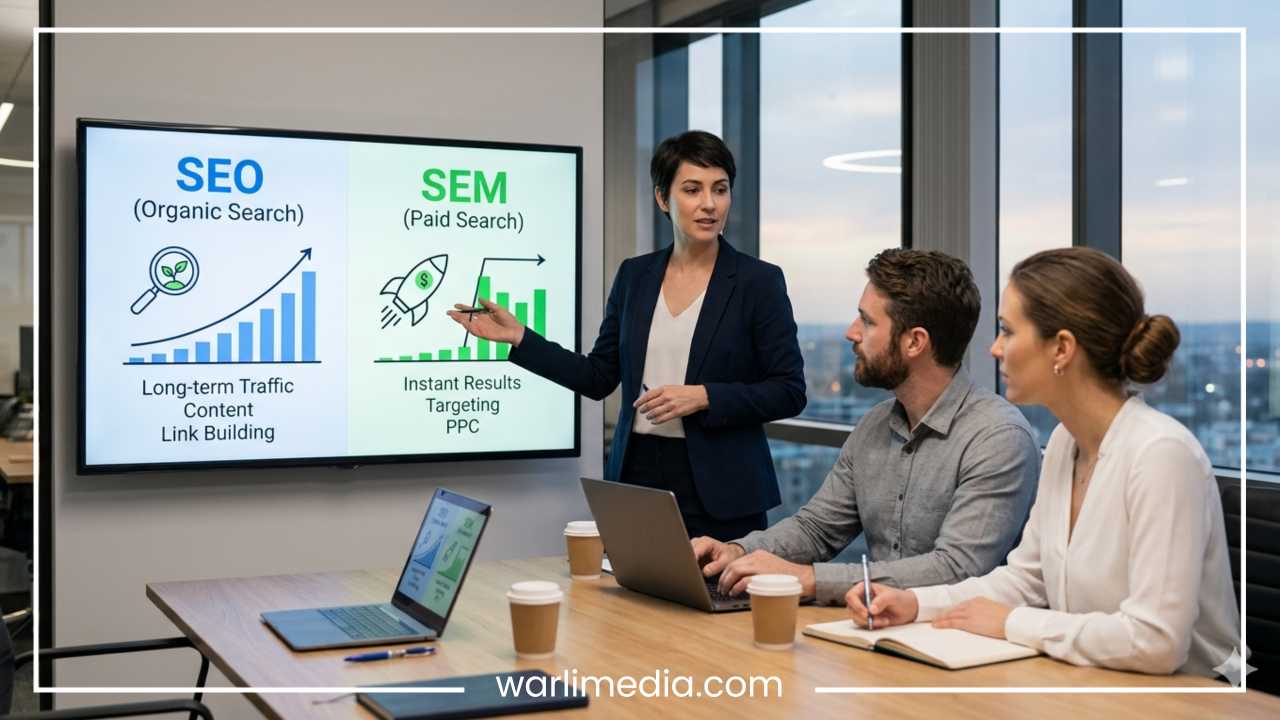
The primary advantage of SEM is immediacy. While SEO takes months, an SEM campaign can be launched in minutes, putting your brand at the top of the search results instantly. It also offers granular targeting, allowing you to show ads based on location, time of day, and even the type of device the user is using.
The downside is cost. Every click costs money, and in competitive industries, these costs can be substantial. Furthermore, SEM is a “pay-to-play” system. The moment you stop spending your budget, your visibility disappears entirely. There is no residual “equity” built in the way there is with organic content.
Key Differences Between SEO and SEM
To choose the right strategy, it is essential to compare these two approaches side-by-side. While they share the same platform, their mechanics are distinct.
1. Cost Structure
SEO: Often called “free,” but this is a misnomer. While you don’t pay for the click, you pay for the talent, tools, and time required to create content and optimize the site. However, the cost is an upfront investment that pays off over time.
SEM: This is a direct expense. You pay for every single lead or visitor. It is a variable cost that scales with your traffic.
2. Time to Results
SEO: This is a marathon. It takes time for search engines to recognize your site as an authority. You might not see significant ROI for 6 to 12 months.
SEM: This is a sprint. You can see results and generate leads the same day you launch your campaign.
3. Sustainability and Longevity
SEO: If you stop working on SEO today, your rankings won’t vanish overnight. The content you created continues to provide value and attract traffic for a long time.
SEM: If you stop your ad spend, your traffic drops to zero immediately.
4. Click-Through Rate (CTR) and Trust
SEO: Generally, organic results have a higher click-through rate than ads. Users tend to trust organic listings more, perceiving them as more “earned” and objective.
SEM: While ads appear at the top, many users intentionally skip over them to reach organic results. However, for high-intent “buy” keywords (e.g., “best lawn mower price”), ads often perform very well.
5. Control
SEO: You have limited control. You can optimize your site, but you cannot force Google to display your meta description exactly as written, nor can you guarantee a specific rank.
SEM: You have a high degree of control. You choose the ad copy, the landing page, and exactly who sees your ad.
Comparison Table: SEO vs. SEM
| Feature | SEO (Organic) | SEM (Paid) |
| Cost | Cost of time and resources | Cost per click (PPC) |
| Speed | Slow (Months) | Instant (Minutes) |
| Placement | Middle of SERP | Top and bottom of SERP |
| Longevity | Permanent (with maintenance) | Temporary (stops with budget) |
| Trust | High user trust | Lower user trust (labeled as ads) |
| Scalability | Harder to scale quickly | Easy to scale with budget |
How SEO and SEM Work Together
The most successful digital marketing strategies do not treat SEO and SEM as rivals, but as teammates. When used in tandem, they create a “search synergy” that is greater than the sum of its parts.
Using SEM for Keyword Testing
Because SEO takes so long to show results, it can be risky to spend six months trying to rank for a keyword that might not actually convert into sales. You can use SEM to run “test” campaigns. By paying for traffic for a specific keyword for a few weeks, you can see if that traffic actually leads to purchases. If it does, you can then confidently invest in a long-term SEO strategy for that term.
Dominating the SERP Real Estate
If you rank high organically for a keyword and you also run an ad for that same keyword, you occupy a massive amount of “above the fold” space on the screen. This increases the probability of a click and reinforces your brand’s authority in that niche. If a user sees you in both the paid and organic sections, they are more likely to perceive you as a market leader.
Retargeting Strategies
SEO is great for bringing in top-of-funnel traffic—people who are just starting their research. However, these people often leave without buying. You can use SEM (specifically remarketing ads) to follow those organic visitors around the internet or back to search, reminding them of your brand until they are ready to convert.
Closing the Content Gap
If you have a high-performing blog post (SEO) that draws in traffic but lacks a clear “buy” signal, you can use SEM to target those same users with direct-response ads for the product mentioned in the post. This creates a full-funnel experience where SEO handles the education and SEM handles the closing.
When to Use SEO
SEO should be the backbone of most digital strategies, but it is especially critical in specific scenarios:
When You Have a Tight Budget: If you have more time than money, SEO is the way to go. You can write your own content and perform basic on-page optimizations to build value without a daily ad spend.
When You Want to Build Authority: If you want to be the “go-to” resource in your niche, high-quality organic content is the only way to build that level of trust with an audience.
For Evergreen Content: If your business revolves around topics that don’t change often (e.g., “how to bake a cake”), SEO allows you to capture traffic for years based on a single piece of work.
Top-of-Funnel Marketing: When users are in the “informational” stage of their journey, they aren’t looking for an ad; they are looking for an answer. SEO is the best tool for providing those answers.
When to Use SEM
SEM is a powerful tool that should be deployed strategically:
For New Product Launches: When you have a new product and zero organic presence, SEM provides the “oxygen” your business needs to get started.
During Seasonal Promotions: For events like Black Friday or Valentine’s Day, you don’t have time to wait for SEO. You need to be visible for those specific weeks, making SEM the ideal choice.
When Your Competitors are Dominating: If your competitors are outranking you organically and you need to break through, bidding on their brand terms or the keywords they own can give you a foothold.
For High-Intent Commercial Keywords: When people search for “emergency plumber near me,” they are ready to spend money right now. In these “emergency” or high-intent scenarios, being at the very top via an ad is vital.
SEO vs. SEM: Which is Better?
The question “Which is better?” is a fundamental misunderstanding of search marketing. It is like asking whether a hammer or a screwdriver is better—the answer depends entirely on the task at hand.
Choosing Based on Budget
If you have a massive budget and need results today, SEM is your best friend. If you are playing the long game and want to minimize your customer acquisition cost over time, SEO is the superior investment.
Choosing Based on Timeline
Short-term goals require SEM. Long-term brand health requires SEO.
The Hybrid Approach
For 90% of businesses, a hybrid approach is the most effective.
Phase 1: Start with SEM to generate immediate leads and gather data on which keywords convert.
Phase 2: Use that data to inform your SEO content strategy.
Phase 3: As your organic rankings rise, you can potentially lower your SEM spend on those specific keywords, shifting that budget to test new areas.
Common Myths About SEO and SEM
Even experienced marketers can fall prey to common misconceptions. Let’s clear some of these up:
“SEO is Free”: As established, SEO requires a significant investment in content creation, technical development, and link building. It is “unpaid” in terms of ad spend, but it is not free in terms of resources.
“Running Ads Helps Your Organic Ranking”: This is a persistent myth. Google keeps a strict “church and state” separation between its search department and its ads department. Spending a million dollars on Google Ads will not directly move your organic ranking up by a single spot.
“SEO is Dead”: People have been saying SEO is dead for over a decade. As long as people use search engines to find information, SEO will exist. It simply evolves.
“SEM is Just for Big Companies”: Because of the PPC model, small businesses can compete by targeting niche, “long-tail” keywords that bigger competitors might overlook.
Future Trends in SEO and SEM
Search marketing is not a static field. It is constantly influenced by technological advancements and changes in human behavior.
1. Artificial Intelligence (AI)
Search engines are increasingly using AI to understand the intent behind a query rather than just matching keywords. This means that “keyword stuffing” is long gone. For SEO, this means focusing on “topical authority” and depth. For SEM, AI is being used to automate bidding and generate ad copy variations.
2. Voice and Visual Search
As more people use voice assistants (like Alexa or Siri), search queries are becoming more conversational and longer. This changes how we target keywords. Similarly, visual search (searching with an image) is becoming a standard feature, requiring marketers to optimize image alt-text and metadata more than ever.
3. Personalization and Privacy
With the phasing out of third-party cookies and a greater emphasis on user privacy, SEM is moving away from hyper-specific tracking and toward “interest-based” targeting. SEO remains a powerhouse in this environment because it relies on the user’s explicit search query rather than their tracking history.
4. Algorithm Updates
Google updates its core algorithm several times a year. These updates increasingly prioritize “Experience, Expertise, Authoritativeness, and Trustworthiness” (E-E-A-T). For SEO, this means that the “who” behind the content matters as much as the “what.”
Final Thoughts
Understanding the difference between SEO and SEM is not just an academic exercise; it is a prerequisite for business growth in the digital age. SEO is the slow-burning fire that builds warmth and sustainability over time, creating a foundation of trust and organic reach. SEM is the high-octane fuel that provides immediate heat and visibility, allowing you to scale quickly and target specific goals.
Rather than choosing one over the other, aim to find the balance that suits your specific business stage, budget, and goals. By combining the trust-building power of SEO with the precision and speed of SEM, you can create a comprehensive search strategy that captures users at every stage of their journey—from their first curious question to their final click of the “buy” button.
The search landscape will continue to change, but the core principle remains the same: provide value to the user, and the search engine will reward you. Whether you pay for that reward or earn it through hard work, the key is to start today.