
How Google Ranks Websites: Ranking Factors Explained
Every second, tens of thousands of search queries are typed into Google. For businesses, content creators, and casual users alike, the order in which results appear on the screen is not an accident. It is the outcome of a highly sophisticated evaluation process known as ranking. In the digital landscape, ranking represents the ultimate measure of visibility. Appearing on the first page of search results can transform a business, driving organic traffic, building brand authority, and generating consistent revenue. Conversely, languishing on the second or third page often means remaining practically invisible to the vast majority of web users.
To manage this massive influx of information, Google utilizes a highly complex, multi-layered system composed of hundreds of individual ranking signals. Over the years, these signals have evolved from simple keyword-matching scripts into highly advanced machine learning architectures capable of understanding context, nuance, and human behavior. While the specific mathematical weights of the algorithm remain a closely guarded trade secret to prevent manipulation, the foundational principles guiding the system are well-documented. This guide simplifies the intricate mechanics behind how Google evaluates and orders web content, bridging the gap between algorithmic theory and practical digital visibility.
Read: Your Start-Up Legal Checklist
How Google Search Works
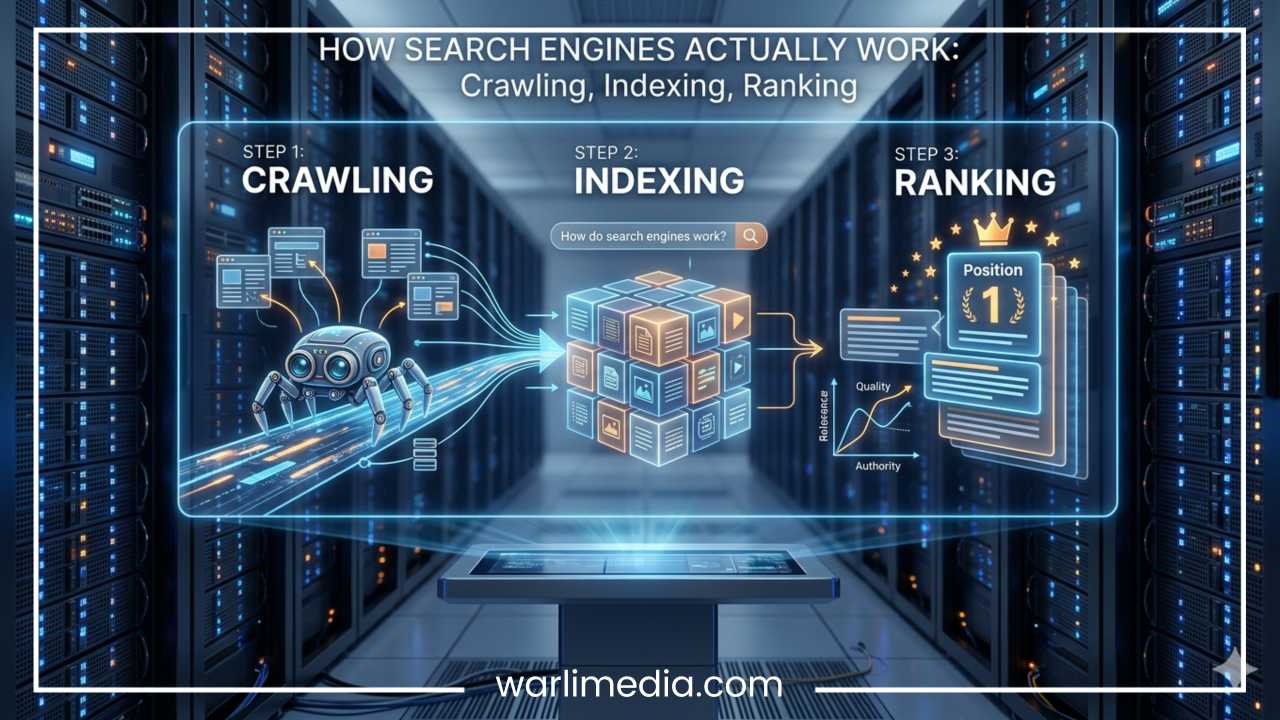
To understand how Google ranks websites, one must first understand how Google builds and maintains its massive map of the internet. Ranking is actually the final phase of a three-part technical pipeline: crawling, indexing, and ranking. An unindexed page cannot be ranked, no matter how exceptionally written or structurally sound it may be.
The process begins with crawling. Google deploys automated software programs known as crawlers or spiders, officially referred to as Googlebot. These crawlers continuously traverse the web, moving from one page to another by following hyperlinks. When Googlebot visits a page, it reads the entire code, discovering text, images, videos, and links to new pages. If a website lacks internal links or is blocked by specific technical directives, Googlebot may never discover it.
Once a page is crawled, the data is sent to the indexing phase. Indexing is the process of parsing, analyzing, and storing the page content in Google’s colossal database, known as the Search Index. Think of the Search Index as the ultimate library catalog of the internet, containing billions of web pages. During indexing, Google determines what the page is about by evaluating its textual content, structural tags, and media elements.
The final stage is ranking, which is triggered the moment a user inputs a search query. When a search is performed, Google does not scan the live internet in real time; instead, it searches its internal index. The ranking algorithms instantaneously evaluate the query against billions of indexed pages, deciding the exact sequence in which the most relevant, reliable, and user-friendly pages should appear.
Read: How Your Reputation Can Effect When Starting a Business?
Google’s Core Ranking Goal
At its core, Google operates with a singular, consumer-centric mission: to deliver the most relevant, useful, and trustworthy results to the user as quickly as possible. Every algorithm update, technical shift, and policy change is designed to serve this fundamental objective. Google does not prioritize websites based on who wants to be found; it prioritizes content based on what the searcher needs to discover.
In the early days of search engine history, matching a query to a webpage was primarily a matter of counting keywords. If a user searched for a specific term, the page that repeated that term the most times was frequently deemed the most relevant. Google recognized that this approach degraded user experience, leading to low-quality, repetitive content designed for bots rather than humans. Modern search algorithms have shifted entirely toward matching search intent and satisfying the user experience.
The core philosophy governing search today can be summarized as providing the best answer for the user’s intent. To achieve this, Google’s systems must evaluate not only the literal words typed into the search bar but also the underlying problem the user is trying to solve. A truly successful ranking website is one that comprehensively answers a user’s question, resolves their dilemma, or guides them effortlessly to their intended destination.
Read: The Ultimate Guide to Mastering Instagram
Search Intent
Search intent, often called user intent, is the underlying reason why a person conducts a specific online search. Understanding and optimizing for search intent is the single most critical element of modern search engine optimization. If a webpage does not align perfectly with what the user hopes to achieve, the algorithm will eventually displace it in favor of pages that do, regardless of how many backlinks or technical optimizations the page possesses.
Google broadly categorizes search intent into four primary buckets, each requiring a fundamentally different type of content structure and presentation.
Informational Intent
The user is seeking knowledge, answers to specific questions, or deep explanations of a topic. Queries often begin with words like how, what, why, or history of. Examples include how to change a flat tire or what causes inflation. The ideal content for informational intent is comprehensive, educational, well-structured, and highly objective, such as detailed guides, essays, and tutorials.
Navigational Intent
The user already knows exactly which website or brand they want to visit but finds it faster to type the name into a search engine rather than entering the full URL in the browser address bar. Examples include Facebook login or bank of america online portal. For navigational intent, Google almost exclusively ranks the official homepage or the precise landing page of the requested entity at the top of the results.
Transactional Intent
The user has reached the final stage of the buying cycle and is actively looking to make a purchase, download a file, or sign up for a service immediately. Queries often include action words like buy, discount, price, or order. Examples include buy wireless headphones or cheap flight to london. Webpages that rank well for transactional intent are streamlined ecommerce product pages, sales landing pages, and service checkout forms that minimize friction.
Commercial Investigation
The user intends to buy something in the near future but requires additional time to research, compare options, read reviews, and weigh alternatives before committing financially. Queries often incorporate words like best, review, top, or versus. Examples include best running shoes for flat feet or laptop vs tablet for college. Content that satisfies commercial investigation includes unbiased comparison charts, detailed product reviews, and curated lists.
Google analyzes user behavior patterns and global search data to determine the predominant intent behind every query. If a website attempts to rank an ecommerce product page for an informational query, it will fail because users searching that term want to learn, not buy. Alignment between the target query’s intent and the content design is mandatory for sustainable visibility.
Content Relevance and Quality
Content remains the foundation of search engine rankings. However, the definition of high-quality content has shifted significantly over time. Google demands material that offers genuine depth, value, and structural clarity, discarding superficial copy that fails to educate or engage.
Beyond Keyword Stuffing
Keyword relevance is still foundational, but its application has completely transformed. Historically, webmasters practiced keyword stuffing, loading pages with repetitive phrases to trick algorithms. Today, Google uses sophisticated semantic search processing. Semantic search focuses on understanding the conceptual meaning of a query and the contextual relationships between words, rather than treating words as isolated strings of text.
Instead of looking for a single repeated phrase, Google looks for a natural ecosystem of related terms, synonyms, and topical concepts. For instance, if a page is truly about baking sourdough bread, it should naturally mention wild yeast, fermentation time, hydration percentages, Dutch ovens, and scoring the dough. The presence of these related terms signals to the algorithm that the content possesses genuine topical depth.
Structure, Depth, and Freshness
High-quality content must be structurally accessible. Google favors pages that use clear heading hierarchies to organize information logically. This helps search engine bots parse the semantic framework of the text, while simultaneously allowing human readers to skim the document and find answers quickly.
Topic depth and comprehensiveness are equally vital. Google favors content that addresses a topic thoroughly, anticipating the user’s logical next steps or follow-up questions. However, depth should not be confused with unnecessary length; fluff or filler text hurts user retention, which hurts rankings.
Furthermore, content freshness heavily influences specific queries. For time-sensitive topics, such as breaking news, political updates, technological breakthroughs, or annual statistics, Google implements algorithms designed to prioritize recently published or significantly updated pages. For evergreen topics, consistency and accuracy matter more than daily updates, though regular historical revisions to keep data accurate are highly rewarded.
Authority and Backlinks
If content relevance determines whether a page is eligible to answer a query, authority determines how high that page should be placed relative to its competitors. Google assesses a website’s authority by examining its relationship with the rest of the web, primarily through hyperlinks.
The PageRank Philosophy
The bedrock of Google’s original ranking breakthrough is an algorithm called PageRank. Developed by Google’s founders, PageRank treats a hyperlink from one website to another as a digital vote of confidence. When Site A links to Site B, it is effectively telling search engines and users that Site B contains valuable, trustworthy information worth referencing.
However, not all votes are created equal. The modern iteration of Google’s algorithm places immense emphasis on the quality of backlinks over the sheer quantity. A single link from an established, highly respected domain, such as a major national newspaper, an accredited university, or a leading industry journal, carries significantly more algorithmic weight than hundreds of links from obscure, low-quality blogs.
Trustworthiness and Link Naturalness
Google evaluates links based on several critical criteria:
Topical Relevance: A backlink carries much more weight if it comes from a site within the same niche. A link from a veterinary clinic pointing to a pet food review site is logical and valuable; a link from an automotive repair shop pointing to that same pet food site is contextually disconnected and viewed with skepticism.
Domain Authority: The inherent trust and power of the linking site itself flow through hyperlinks. Sites with clean, long-standing backlink profiles pass more link equity down the line.
Anchor Text Context: The clickable text used to highlight a link provides Google with contextual clues about the target page’s topic. Anchor text should look natural and descriptive, rather than overly optimized with repetitive commercial keywords.
Google explicitly penalizes artificial link manipulation. Buying backlinks, participating in private blog networks, or mass-generating links via automated comment spam violates webmaster guidelines. The algorithm is adept at distinguishing between natural editorial links, which are earned through exceptional content, and manipulative links, which are designed to artificially inflate authority metrics. Additionally, internal linking, the practice of linking between pages within the same website, helps distribute authority evenly across a domain while mapping out a logical navigation path for search bots.
E-E-A-T Signals
In its ongoing effort to combat misinformation and surface the highest-tier information, Google utilizes an evaluative framework known as E-E-A-T. This acronym stands for Experience, Expertise, Authoritativeness, and Trustworthiness. While E-E-A-T is not a single, isolated ranking score, it represents a core structural guide that Google trains its human Search Quality Raters to look for, and its engineers write algorithms to mimic.
The Four Pillars of Quality
Experience assesses whether the creator of the content has first-hand, real-world experience with the subject matter. For example, a product review written by someone who has physically tested a device for a month is vastly more valuable than a summary rewritten from an online product description.
Expertise looks at the formal credentials, education, and professional standing of the content creator. For highly specialized topics, a paper authored by an individual holding an advanced degree or recognized industry certification carries far more weight than an anonymous post.
Authoritativeness refers to the overall reputation of the website and the author within their specific niche. When other recognized experts or authoritative websites repeatedly cite a creator or platform as a definitive source of information, their authoritativeness grows.
Trustworthiness is the most critical pillar of the framework. Trustworthiness evaluates the clarity, honesty, and safety of the website. This includes having transparent editorial policies, clear author biographies, easily accessible contact information, and a secure technical foundation.
Your Money or Your Life (YMYL)
The implementation of E-E-A-T signals becomes exceptionally strict on pages designated as Your Money or Your Life (YMYL). Google defines YMYL pages as content that could directly impact a user’s health, financial stability, legal safety, or future happiness.
Medical advice websites, investment blogs, legal repositories, and news outlets covering critical global events are subjected to extreme scrutiny. If an unverified blog gives inaccurate medical diagnoses, the real-world harm can be severe. Therefore, Google’s algorithms aggressively demand verifiable expert authorship, extensively cited scientific research, and immaculate transparency before allowing YMYL content to occupy top positions in search results.
User Experience Signals
While content and authority tell Google what a page is about and how much it can be trusted, user experience signals tell Google how real people interact with that page. A website can have brilliant prose, but if it takes too long to load or distorts on a smartphone screen, visitors will leave out of frustration. Google tracks these behavioral patterns and structural indicators to assess satisfaction levels.
One critical avenue is engagement. While Google has repeatedly stated that raw, uncontextualized metrics like bounce rate are not direct ranking inputs due to statistical noise, the broader concept of user engagement is undeniably part of the ecosystem. If a user clicks a search result, immediately hits the back button because the page was confusing or broken, and clicks a competitor’s link instead, this behavior signals a systemic mismatch. Conversely, prolonged time on page and deep scroll depths indicate that the content successfully answered the searcher’s query.
Furthermore, technical user experience indicators are tracked explicitly through system benchmarks:
Mobile Friendliness: The vast majority of global web traffic originates from mobile devices. Google operates on a system of mobile-first indexing, meaning it evaluates the mobile version of a webpage for ranking before it ever looks at the desktop version. If a site fails to render correctly on mobile screens, its overall visibility drops.
Page Speed and Core Web Vitals: Google quantifies page speed through a set of real-world user experience metrics called Core Web Vitals. These metrics measure how quickly the largest visual elements load, how rapidly the page becomes responsive to user inputs, and how visually stable the elements are as they render. Slow pages cause user abandonment, and Google downgrades slow sites to protect users from poor web experiences.
Technical SEO Factors
Technical SEO is the practice of optimizing a website’s underlying code and server architecture to help search engine crawlers find, read, and index pages without errors. If a site has profound technical flaws, Googlebot may fail to crawl it, rendering all content optimization useless.
| Technical Element | Core Function | Impact on Search Ranking |
| Crawlability & Indexing | Managed via robots.txt and XML sitemaps to direct Googlebot efficiently. | Ensures new content is found and indexed quickly; prevents crawl budget waste. |
| HTTPS Security | Encrypts data transmitted between the user’s browser and the hosting server. | Acts as a direct ranking signal; unsecure HTTP sites are labeled unsafe. |
| Structured Data | Uses standardized schema markup code to define explicit context. | Enables rich snippets in search results, increasing visibility and click-through rates. |
| URL Architecture | Uses short, logical, lowercase, and keyword-descriptive URL paths. | Helps search bots and human users understand context and site hierarchy instantly. |
Crawlability and Indexing Efficiency
The first layer of technical SEO centers on accessibility. Webmasters use a text file called robots.txt to give clear instructions to Googlebot regarding which folders should be ignored and which should be explored. Concurrently, an XML sitemap acts as a map of the site’s most critical pages, allowing Google to quickly discover new or updated URLs. If a technical error mistakenly blocks Googlebot from accessing vital sections of a site, those pages will drop out of search results entirely.
Security and Structured Enhancements
Site security is a mandatory baseline requirement. Google utilizes HTTPS as a ranking signal. Websites running on the old, unencrypted HTTP protocol are actively flagged as insecure by browsers, causing user drop-off and algorithmic downgrades.
Additionally, implementing structured data, also known as schema markup, provides clear context directly to search engines. Schema is a specific vocabulary of code added to a site that explicitly tells Google what an asset means. For example, schema can clarify that a specific number is a product price, an author name, a recipe ingredient, or a review score. This clean data structure enables Google to display rich snippets, such as star ratings, event dates, or FAQ dropdowns, directly in the search results, driving higher click-through rates.
Freshness and Updates
Google recognizes that information is dynamic, not static. The value of an answer often depends heavily on when it was provided. To accommodate this reality, Google employs an algorithmic system frequently referred to as Query Deserves Freshness.
When a major news event occurs, a natural disaster strikes, a company releases its quarterly earnings, or a pop culture phenomenon goes viral, user search patterns shift dramatically. Google’s algorithms detect this sudden spike in search volume and social chatter around specific keywords. The system temporarily adjusts its standard authority requirements, boosting newly published articles, breaking news reports, and live blog feeds to the top of the search engine results pages.
When a sudden traffic spike or new event is detected, the Query Deserves Freshness algorithm activates to grant a temporary ranking boost for brand new articles, while temporarily de-prioritizing historic or static guides.
However, freshness is not reserved solely for breaking news. For competitive informational topics, regular updates are essential. If an article detailing the best digital marketing strategies was written years ago, its advice may now be completely obsolete. Google favors websites that systematically audit their historical content, removing broken links, updating outdated statistics, expanding on new developments, and republishing the content with clear indicators of revision. This practice signals to Google that the content remains highly accurate and reliable for current searchers.
Personalization and Location
Two users typing the exact same query into the search bar at the exact same moment will not necessarily see identical search results. Google customizes results based on a variety of contextual factors to maximize individual relevance.
The Power of Local Context
Location data is one of the most powerful modifiers in the ranking ecosystem. For queries with local intent, such as car repair shop, dental clinic, or best pizza, Google heavily favors proximity. The algorithm cross-references the user’s IP address or mobile GPS coordinates with registered businesses in the area, displaying a localized map packet along with localized web results. A world-famous pizzeria located a thousand miles away will be bypassed in favor of a highly reviewed local establishment situated three blocks from the user’s current position.
History and Device Adaptations
Beyond physical geography, personal browsing history shapes search results. If a user frequently visits a particular hobbyist blog or news outlet, Google’s systems note that preference and may occasionally rank that domain slightly higher for that specific individual’s future queries.
Device type also influences the layout and ranking of results. Desktop searches may favor highly complex, deep data tables or lengthy academic PDFs, while mobile searches prioritize streamlined, fast-loading, tap-friendly pages. This real-time adaptation ensures that the content served fits the device constraints of the user.
Machine Learning in Ranking
Modern search has evolved beyond static rules written by human engineers. Today, Google utilizes an ecosystem of advanced artificial intelligence and machine learning models that interpret search data dynamically, learning from user patterns to refine how information is categorized and displayed.
Interpreting Complex Queries
The foundation of Google’s AI integration began with RankBrain. Introduced to handle completely unique queries that Google had never encountered before, RankBrain functions as a conceptual translator. Instead of looking at an unfamiliar phrase literally, it maps the query to similar, understood concepts, ensuring the user receives accurate answers even if they phrased their question poorly.
Following RankBrain, Google introduced deeply sophisticated Natural Language Processing models based on the BERT framework. BERT is designed to process words in relation to all the other words in a sentence, rather than one by one in order. This allows the system to comprehend the vital nuance of prepositions like for, to, or from. For example, in the phrase patient needs help picking up medicine from clinic, a traditional keyword search might get confused about who is traveling where. BERT allows Google to understand the exact direction of intent, serving highly relevant results based on context.
The Shift Toward Multimodal Understanding
Building upon these natural language advancements, Google integrated its Multimodal Unified Model, known as MUM. This technology is incredibly advanced, capable of processing information across multiple modalities simultaneously, including text, images, video, and audio. MUM can understand complex, multi-layered queries and cross-reference answers across different languages. If a user uploads an image of a specific hiking boot and asks can I use these to hike Mt Fuji next month, MUM interprets the physical features of the boot in the photo, analyzes the terrain data of Mount Fuji, and surfaces an accurate answer, even if the primary source material is written in Japanese.
Common Myths About Google Ranking
The high stakes of search visibility have given rise to a vast ecosystem of speculation, leading to several persistent myths that can misdirect content creators and webmasters.
Myth: SEO is just keywords. Many people believe that ranking is simply a matter of inserting a specific keyword a set number of times into a text. As explored via semantic search and AI models, Google understands topics conceptually. Focusing entirely on a single keyword while producing generic content results in poor user engagement and low rankings.
Myth: Google prefers big websites only. While large brands enjoy massive natural backlink authority, Google does not possess an inherent filter that automatically blocks smaller websites. A specialized niche blog that produces deep, highly accurate content matching informational search intent can regularly outrank massive corporate sites that only cover the topic superficially.
Myth: Posting daily guarantees ranking. Content volume does not equal content value. Publishing low-quality, rushed articles daily provides zero algorithmic benefit. Google would rather see a website publish one truly exceptional, deeply researched, and authoritative piece of content once a month than thirty mediocre pages that add no unique value to the web index.
Myth: Backlinks are dead. With the rise of user experience signals and artificial intelligence, some speculate that backlinks have lost their value. This is untrue. Backlinks remain one of the foundational mechanisms Google uses to verify cross-domain trust and authority. The difference today is that spammy, automated links are ignored or penalized, making high-quality editorial links more critical than ever.
How to Improve Rankings
Translating the mechanics of Google’s ranking system into an actionable strategy requires a holistic approach that prioritizes the user experience while respecting technical parameters.
Focus on Intent, Not Keywords
Begin every content creation process by investigating the precise search intent of the target query. Analyze the existing top-performing results on Google to see if the engine prefers long-form guides, videos, product pages, or comparative lists. Design your page structure to match that exact consumer expectation.
Commit to Topical Depth and Structural Clarity
Write content that addresses a subject thoroughly. Anticipate and answer follow-up questions within the same document to provide a seamless user journey. Use descriptive headings to break up long blocks of text, allowing both human users and Googlebot to navigate the hierarchy of your ideas easily.
Earn Natural Authority
Build backlinks by creating original, high-value resources worth citing. Invest time in producing proprietary data studies, unique infographics, expert interviews, or definitive reference manuals. When your content is genuinely original and authoritative, other websites will naturally link back to it as a foundational source.
Optimize Technical Health and Speed
Ensure your website loads quickly by compressing heavy image files, leveraging browser caching, and cleaning up messy code repositories. Regularly test your site’s mobile responsive layout and maintain a secure HTTPS connection across all active pages.
Cultivate E-E-A-T and Freshness
Be transparent about who authored your content by including detailed biographies, professional credentials, and external links to verified profiles. Cite trustworthy references when making health, financial, or technical claims. Finally, establish a regular content audit schedule to revise outdated statistics and refresh evergreen pages with accurate, modern data.
Final Thoughts
Google’s ranking ecosystem is a monumentally complex, ever-evolving architecture driven by a simple goal: providing users with immediate access to the most relevant, reliable, and user-friendly answers available on the web. While the underlying technology relies on a web of advanced elements—from mechanical crawlers and semantic indexers to cutting-edge machine learning models—the foundational philosophy remains completely human-centric.
Achieving and maintaining top search visibility is not about finding short-term technical loopholes or outsmarting an automated algorithm. True, sustainable search engine visibility is achieved by systematically aligning a website’s content, authority, and technical structure with the authentic needs of its human audience. By focusing on providing clear answers to search intent, maintaining technical health, and earning genuine authority, webmasters can build a powerful digital presence that naturally climbs the rankings.
Frequently Asked Questions
Why is my website not showing up on Google search results
If your website is missing from search results, it usually stems from a fundamental breakdown in the crawling or indexing phase. First, verify that your site has actually been indexed by typing site:yourdomain.com into the search bar. If no pages appear, Googlebot may be technically blocked from accessing your files. Check your robots.txt file to ensure you have not accidentally applied a disallow directive to your main content directories. Alternatively, check your pages for a noindex meta tag embedded in the HTML header code, which explicitly orders search engines to ignore the URL. For brand new websites, discovery simply takes time. You can accelerate this phase by setting up a Google Search Console account and manually submitting your XML sitemap to invite Googlebot to crawl your domain.
How long does it take to rank on the first page of Google
Securing a first-page placement typically takes anywhere from three to twelve months of consistent optimization and content creation. The exact timeline depends heavily on three variables: the age and existing authority of your domain, the competitive difficulty of your target keywords, and the strength of your backlink profile. A brand new website targeting broad, highly competitive commercial phrases will face a lengthy uphill battle because established industry giants already hold those spaces. Conversely, if you target specific, low-competition long-tail queries, you can see meaningful organic ranking movements much faster. SEO is a long-term compound investment rather than an immediate advertising switch.
Does updating old content improve search engine rankings
Yes, systematically updating historical content is one of the fastest ways to recover lost organic traffic and boost rankings. Google favors accurate, up-to-date resources. Over time, exceptional articles can experience a drop in positions as data becomes obsolete, external references turn into broken links, and competitors publish newer material. By updating old statistics, adding fresh paragraphs to cover recent industry shifts, fixing broken links, and optimizing the structural headings, you signal to Google’s algorithms that the webpage remains highly valuable. For competitive topics, a comprehensive refresh can trigger a positive re-evaluation by the index.
How do backlinks affect Google search positioning
Backlinks function as fundamental votes of confidence within Google’s algorithmic infrastructure. When an external website includes a hyperlink pointing back to your content, it signals to search engines that your material is authoritative, accurate, and worth referencing. However, the modern algorithm places quality above raw volume. A single link from an accredited university, a major news organization, or an established authority within your specific niche carries significantly more weight than dozens of links from low-quality web directories or irrelevant personal blogs. Building a natural backlink profile through high-value content remains essential for upward ranking momentum.
Why do my website rankings fluctuate from week to week
Minor ranking shifts are a completely normal characteristic of the search ecosystem. Google continuously rolls out minor algorithmic updates, tweaks ranking signal balances, and refreshes data points within its search index. Furthermore, your competitors are actively optimizing their own sites, building new links, and updating content, which naturally shifts the baseline order. User behavior signals, temporary testing by Google’s systems, and local search variations also contribute to short-term changes. Instead of stressing over day-to-day position drops, analyze your search performance using long-term monthly averages to identify authentic trends.