
White Hat vs Black Hat SEO: Key Differences Explained
Not all SEO strategies are created equal. Some build sustainable rankings, while others can destroy a website’s visibility overnight. In the competitive arena of digital marketing, achieving high visibility on search engines is a primary objective for businesses worldwide. When a brand ranks on the first page of search engine results, it unlocks a continuous stream of organic traffic, builds credibility, and generates revenue without the recurring costs of paid advertising. However, the path chosen to achieve those high rankings determines whether a business enjoys long-term success or suffers catastrophic penalties.
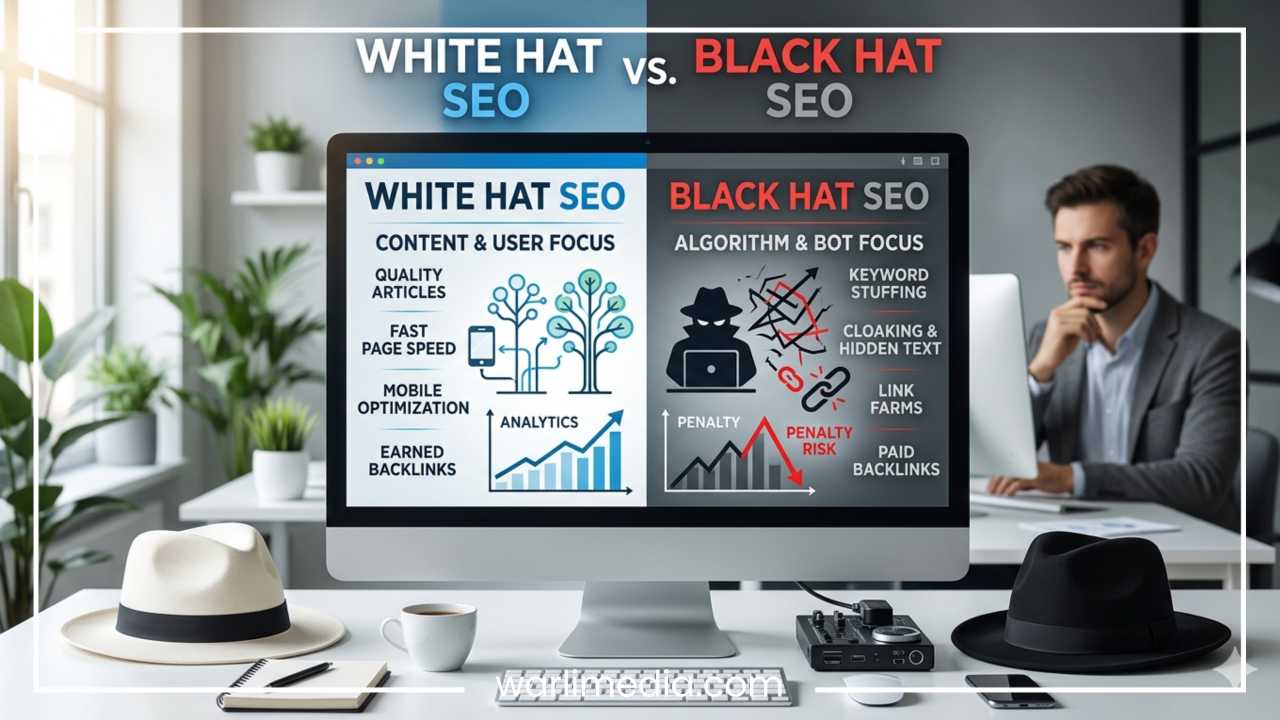
The practice of Search Engine Optimization is divided into two distinct philosophies: White Hat SEO and Black Hat SEO. These terms, borrowed from classic Western films where heroes wore white hats and villains wore black hats, represent the ethical divide in the digital marketing industry. White hat strategies focus on providing real value to human audiences while playing strictly within the boundaries set by search engine guidelines. Black hat strategies rely on manipulative shortcuts designed to exploit loopholes in search algorithms for rapid, temporary gains.
Understanding the mechanics, benefits, and severe risks associated with these opposing methods is essential for any business owner, marketer, or webmaster. While manipulative tactics may offer a fleeting rush of traffic, they carry the constant threat of search engine penalties that can completely deindex a website. Conversely, ethical growth requires patience, but it establishes an unshakeable digital foundation. This comprehensive guide explores the core differences between these approaches, helping you build a sustainable digital presence.
Read: Work From Home: Your Complete Guide
What Is SEO?
Search Engine Optimization, commonly known as SEO, is the art and science of optimizing a website to increase its visibility when people search for products, services, or information related to a business in search engines. The primary goal of SEO is to attract organic traffic—visitors who arrive at a website through unpaid search results rather than sponsored advertisements.
To understand why different optimization philosophies exist, it is necessary to explore how search engines operate. Search engines use complex, proprietary algorithms to evaluate billions of web pages and deliver the most accurate, relevant results to users within milliseconds. This intricate process is broken down into three fundamental stages:
Crawling: Search engines deploy automated software programs, known as bots, spiders, or crawlers, to scour the internet. These crawlers follow links from one page to another, discovery new and updated content, and send that data back to the search engine’s servers.
Indexing: Once a page is crawled, the search engine analyzes its text, images, video files, and overall structural formatting. The page is then stored in a massive database called an index. If a web page is not indexed, it cannot appear in search results.
Ranking: When a user types a query into a search bar, the search engine searches its index to find the most relevant pieces of content. The algorithm evaluates hundreds of ranking signals—including keyword relevance, page speed, mobile responsiveness, and site authority—to determine the order in which pages appear on the Search Engine Results Pages (SERPs).
Businesses invest heavily in SEO because ranking highly on the SERPs is directly correlated with commercial success. The vast majority of user clicks go to the first few organic results on page one. By aligning a website with search engine ranking signals, businesses can dramatically improve their user experience, build domain authority, and capture highly targeted traffic at the exact moment a consumer is looking for a solution.
Read: The Advantages and Disadvantages of Working From Home
What Is White Hat SEO?
White Hat SEO refers to the practice of optimizing a website using ethical strategies that fully align with the terms, conditions, and guidelines set by major search engines like Google and Bing. The foundational principle of white hat optimization is a commitment to prioritizing the human reader over the search engine algorithm. Instead of trying to trick a system into ranking a page, white hat practitioners focus on creating an exceptional online experience that naturally earns its position at the top of the SERPs.
The goals of white hat SEO are inherently tied to long-term sustainability, brand credibility, and genuine audience engagement. Rather than chasing short-lived algorithm exploits, this approach aims to build an authoritative digital asset that remains resilient against frequent search engine updates.
Technical and Content-Driven Topics
An effective white hat strategy requires a holistic approach that balances high-quality content creation with meticulous technical execution. Key components include:
High-Quality Content Creation: Producing original, deeply researched, and comprehensive content that answers user questions, solves problems, and offers clear value that cannot be found elsewhere online.
Strategic Keyword Optimization: Conducting thorough keyword research to understand how prospective customers voice their queries, and naturally integrating those terms into page titles, headings, and body copy without over-optimization.
Technical SEO Excellence: Structuring a website’s underlying code so that search engine crawlers can easily navigate, understand, and index every page without encountering errors.
Mobile Optimization: Designing responsive websites that adapt seamlessly to any screen size, ensuring that mobile users have an identical or superior browsing experience compared to desktop users.
Fast Page Speed: Optimizing images, leveraging browser caching, and minimizing code to ensure that web pages load almost instantly, preventing users from bouncing due to delays.
Thoughtful Internal Linking: Establishing a logical internal link structure that helps users discover related content while distributing equity and context across the entire website.
Enhanced User Experience (UX): Creating intuitive navigation menus, clean layouts, and accessible designs that keep users engaged and reduce frustration.
Earning Backlinks Naturally: Developing outstanding resources, such as data-driven studies, infographics, or expert guides, that prompt other reputable websites to link back to your content voluntarily as a trusted reference.
Read: Visual Branding: The Secret Weapon to Brand Success
Long-Term Strategic Benefits
The benefits of investing in a white hat methodology extend far beyond simple rankings. Because these practices comply fully with webmaster guidelines, websites face minimal risk of being penalized or deindexed during major algorithm rollouts.
Furthermore, prioritizing the user builds immense brand credibility and fosters long-term consumer trust. When visitors repeatedly find accurate, fast, and helpful information on a website, they are far more likely to convert into paying customers and brand advocates. Over time, this consistent user satisfaction signals to search engines that the site is an industry authority, creating a self-sustaining cycle of high rankings and compounding organic traffic growth.
Real-World Examples
To visualize white hat SEO in action, consider a company that publishes an exhaustive, step-by-step guide on how to manage personal finances. The guide features original interactive calculators, interviews with certified financial planners, and clear headings. The technical team ensures the page loads in under two seconds and displays perfectly on smartphones.
Because the guide is incredibly helpful, personal finance bloggers and news outlets begin linking to it as a resource. The company also optimizes its title tags and meta descriptions to accurately reflect the guide’s contents. This is the definition of ethical SEO: it helps the user first, and as a result, the search engine rewards it.
What Is Black Hat SEO?
Black Hat SEO consists of a collection of manipulative tactics, exploits, and deceptive practices designed to trick search engine algorithms into awarding a website higher rankings than it has actually earned. This philosophy completely disregards search engine terms of service and focuses entirely on gaming the system. Unlike white hat practitioners, those who deploy black hat techniques do not design their websites for human users; their sole target is the automated algorithm.
The primary motivation behind black hat SEO is speed and immediate financial return. Developing a legitimate digital brand through ethical means requires a significant investment of time, money, and labor. Black hat tactics appeal to individuals looking for quick traffic gains, immediate lead generation, or rapid ad revenue before search engines discover the deception.
Deceptive and Manipulative Tactics
Black hat practitioners utilize an array of deceptive techniques to artificially inflate their search visibility. Some of the most common practices include:
Keyword Stuffing: Overloading a web page with repetitive, unnatural lists of keywords in a desperate attempt to manipulate relevance scores. This results in blocks of text that are completely unreadable to humans.
Cloaking: Presenting one version of a web page to search engine crawlers to secure a high ranking, while displaying an entirely different, often spammy or unrelated version to human visitors.
Hidden Text and Links: Concealing keywords or links from human eyes by making the text color identical to the background color, setting the font size to zero, or hiding text behind images.
Link Farms: Participating in or creating networks of low-quality websites that exist solely to link to one another, creating an illusion of popularity and authority.
Buying Backlinks: Paying third-party webmasters or services to place links on their sites to pass artificial ranking equity, directly violating guidelines against link manipulation.
Duplicate Content and Scraping: Copying large blocks of text or entire articles from authoritative websites and republishing them without permission, value addition, or proper attribution.
Spam Comments: Utilizing automated bots to leave generic comments containing links to a target website across thousands of unrelated blogs, forums, and discussion boards.
Private Blog Networks (PBNs): Buying expired domains that already possess historical authority and turning them into a secret network of sites used exclusively to link back to a primary money website.
Severe Business Risks
While black hat SEO can produce short-term traffic spikes, the long-term consequences are devastating for legitimate businesses. Search engines have spent decades refining their automated detection systems. When a website is caught engaging in black hat behavior, it faces severe Google penalties.
These penalties can take the form of an algorithmic demotion, which causes a site’s search visibility to plummet across all keywords, or a manual action, where a human reviewer strips the site of its rankings or removes it from the search index entirely. Once a website is deindexed, its organic traffic drops to zero, destroying its revenue pipeline and causing irreversible damage to the brand’s reputation among consumers and industry peers.
Real-World Examples
A classic example of black hat optimization involves an e-commerce site that copies product descriptions directly from a manufacturer, automatically spins the text using software to make it look unique, and then buys 5,000 low-quality links from a cheap online marketplace to force the page onto page one.
Similarly, websites that leverage spammy, automated AI generators to pump out thousands of low-value, repetitive articles an hour are engaging in black hat automation. These sites may enjoy a brief moment of visibility, but as soon as a search engine update rolls out, their traffic charts drop to zero, rendering their entire investment worthless.
White Hat vs Black Hat SEO: Key Differences
The distinctions between white hat and black hat SEO go far beyond compliance with a set of corporate rules. They represent completely opposing business models, risk tolerances, and approaches to digital asset creation. To clearly illustrate how these two philosophies contrast across critical performance indicators, review the comparison table below:
| Factor | White Hat SEO | Black Hat SEO |
| Primary Focus | Human users and target audience | Search engine algorithms and bots |
| Risk Level | Extremely low risk of penalty | Extremely high risk of deindexing |
| Velocity of Results | Slow, steady, and incremental | Fast, volatile, and short-lived |
| Guideline Compliance | Follows webmaster guidelines fully | Violates search engine terms of service |
| Content Quality | Original, deeply valuable, and readable | Manipulative, thin, scraped, or spun |
| Link Building Approach | Earned naturally through merit and outreach | Artificial creation, buying, or link farms |
| Penalty Exposure | Minimal to none | Severe and highly probable |
| Return on Investment (ROI) | Compounds and increases over time | High initial spike followed by total loss |
Sustainability, ROI, and Ethics
When evaluating the return on investment between these two methodologies, sustainability emerges as the defining differentiator. White hat SEO requires patience; it may take several months of consistent content creation, technical tuning, and relationship building to see significant upward movement in the SERPs. However, once those rankings are secured, they act as a stable, appreciating asset. The cost to maintain those rankings decreases over time while the organic traffic, leads, and sales continue to compound, resulting in a massively positive long-term ROI.
Black hat SEO operates on an entirely different financial timeline. The initial ROI can appear incredibly attractive because minimal effort is spent creating genuine quality, and rankings can rise rapidly. However, this model is fundamentally unsustainable. A black hat site is constantly living on borrowed time. The moment an algorithm update detects the manipulation, the traffic vanishes. The business is then forced to abandon the domain entirely, lose all historical data, and start from scratch with a brand new website, wiping out any initial financial gains.
From an ethical perspective, white hat SEO views the internet as a collaborative ecosystem where businesses succeed by actively contributing to the global pool of knowledge. Black hat SEO treats the web as a system to be exploited, polluting search results with unhelpful spam that degrades the overall user experience. Choosing white hat practices means protecting your brand’s future and ensuring that your digital footprint is built on integrity.
What Is Gray Hat SEO?
Between the clear boundaries of white hat and black hat SEO lies a nebulous middle ground known as Gray Hat SEO. Gray hat techniques involve strategies that do not explicitly violate the letter of search engine guidelines, but distinctly violate the spirit of those rules. These are methods designed to give a website a competitive edge by pushing ethical boundaries as far as possible without triggering an immediate manual penalty.
The defining characteristic of gray hat SEO is ambiguity. Search engines intentionally leave certain aspects of their documentation open to interpretation, and gray hat marketers exploit these gray areas. Common examples of gray hat practices include:
Aggressive Link Exchanges: Setting up excessive “you link to me and I will link to you” agreements with other websites that cross the line from natural networking into systematic manipulation.
Purchasing Expired Domains for Redirection: Buying old, abandoned websites that still have a clean backlink history and using 301 redirects to point that historical authority directly to a new target site, even if the topics are completely unrelated.
AI-Assisted Content Abuse: Utilizing generative artificial intelligence to produce massive quantities of content that is technically original and readable, but lacks any genuine human insight, unique data, or real-world expertise.
Clickbait Titles and Aggressive Interstitials: Crafting sensationalized title tags to force exceptionally high click-through rates from the SERPs, while delivering a page experience that fails to satisfy the exaggerated promise of the headline.
Engaging in gray hat SEO is a calculated gamble. While it allows a website to achieve faster results than pure white hat tactics without the immediate threat associated with black hat methods, it is far from safe. Search engine algorithms are not static; they undergo continuous evolution. What is considered a clever gray hat workaround today can easily be categorized as a black hat violation tomorrow. Marketers who rely on these techniques must constantly monitor algorithm changes, knowing that their entire strategy could be invalidated by a sudden update.
Google Penalties and Algorithm Updates
To maintain user trust, search engines must ensure that their results pages remain free of spam, deception, and low-quality content. They accomplish this monumental task through a combination of continuous algorithmic updates and manual quality reviews. When a website strays from ethical boundaries, it inevitably collides with these protective systems, resulting in severe search penalties.
Manual vs. Algorithmic Penalties
It is crucial to differentiate between the two primary ways search engines punish non-compliant websites:
Manual Penalties: A manual action occurs when a human reviewer at a search engine evaluates a website and determines that it does not comply with webmaster quality guidelines. This usually happens when a site is flagged for explicit violations like cloaking, hidden text, or systemic link buying. When a manual action is issued, the webmaster is notified through their search console, and the site’s rankings drop dramatically, or it is purged from the index.
Algorithmic Penalties: These are automatic adjustments made by the core search engine algorithm without human intervention. When a site’s metrics and architectural patterns match the signature of manipulative tactics, the algorithm automatically reduces its visibility. Unlike manual actions, webmasters do not receive a formal notification; they simply witness a sudden, unexplained collapse in their traffic charts.
Famous Historical Updates
Over the years, Google has launched several landmark updates specifically engineered to combat manipulative SEO tactics. Understanding these updates highlights how search engines view web optimization:
Panda: Originally launched to target websites with thin, duplicate, or low-quality content. It heavily penalized “content farms” that published thousands of poorly written articles just to rank for keywords.
Penguin: This update fundamentally changed link-building practices by specifically targeting websites that engaged in artificial backlink manipulation, comment spam, and link buying.
Helpful Content Update: A major systemic shift designed to reward websites that create content primarily for humans, while systematically suppressing sites created purely for search engine traffic.
Spam Updates: Regular, targeted rollouts that use advanced machine learning systems to detect and neutralize evolving forms of cloaking, hacking, and automated scraping.
Recovering from a search engine penalty is an arduous, stressful, and expensive process. For a manual penalty, a webmaster must meticulously audit their entire site, remove thousands of toxic links, rewrite scraped content, submit a formal reconsideration request, and hope a human reviewer accepts their explanation. For algorithmic penalties, a site must be completely overhauled to meet higher quality standards, and recovery can take many months or even years as the algorithm waits to crawl and re-evaluate the entire domain.
Why White Hat SEO Wins Long-Term
When you look past the immediate allure of rapid traffic shortcuts, it becomes abundantly clear that White Hat SEO is the only viable strategy for building a resilient, profitable, and enduring online business. Ethical optimization wins the long-term game because it works in absolute harmony with the primary business objective of search engines: providing users with the best possible answer to their queries.
Sustainable Traffic and Compounding ROI
The most powerful attribute of white hat SEO is its capacity for sustainable growth. When you publish an authoritative guide, optimize your site architecture, and make your pages load rapidly, you are creating permanent value.
Unlike paid ad campaigns that stop generating leads the second your budget runs out, or black hat pages that disappear after an update, white hat assets continue to attract organic traffic indefinitely. As your site gains history, trust, and more natural editorial links, your older content ranks higher, creating a compounding return on investment where your marketing costs decline relative to the revenue generated.
Trust, Authority, and the Framework of E-E-A-T
Modern search engines place immense emphasis on a quality evaluation framework known as E-E-A-T, which stands for:
Experience: The content demonstrates firsthand, real-world experience with the topic.
Expertise: The author or brand possesses the formal credentials, knowledge, and background necessary to provide accurate information.
Authoritativeness: The website is recognized as a go-to source within its specific niche or industry.
Trustworthiness: The site is secure, transparent, accurate, and behaves with clear integrity toward its visitors.
White hat SEO is natively built around the principles of E-E-A-T. By focusing on deep research, transparent citations, expert authorship, and flawless user experiences, you signal to both human visitors and automated search algorithms that your brand is a trustworthy authority. This deep-seated trust drastically improves conversion rates, transforming casual searchers into loyal, paying clients who trust your brand over competitors who use sketchy techniques.
Ethical SEO Best Practices
To succeed in the modern digital ecosystem without risking penalties, businesses must execute a proactive, ethical SEO strategy. The following actionable best practices are designed to help you construct an authoritative website that search engines love to reward:
Create Truly Original and In-Depth Content
Never copy, scrape, or lightly rewrite existing articles. Conduct original research, interview internal subject matter experts, compile unique case studies, and present your findings in a clear, engaging format. Focus on answering the user’s search intent completely so they do not need to return to the search results to find another source.
Optimize for User Search Intent
Before writing a single word, analyze the SERPs for your target keywords to understand what users are actually looking for. Are they seeking information, trying to buy a product, or looking for a specific website? Structure your content format—whether it is a long-form article, a product page, or a comparison table—to match that exact intent.
Prioritize Technical Performance and Page Speed
Invest in premium web hosting, compress all images before uploading them, utilize clean code structures, and eliminate unnecessary plugins. Ensure your website comfortably passes Core Web Vitals assessments, which measure loading performance, visual stability, and interactivity.
Design a Flawless Mobile Experience
Adopt a mobile-first design philosophy. Test your website across a wide variety of smartphones and tablets to ensure that navigation menus are easy to tap, text is highly legible without zooming, and pop-ups do not obstruct the primary content.
Build Relationships for Natural Backlinks
Instead of buying links or joining shady networks, focus on digital PR and relationship building. Reach out to industry journalists, reputable bloggers, and podcast hosts to offer your unique insights, guest contributions, or data reports. When your content is genuinely outstanding, authoritative links follow naturally.
Leverage Structured Data Appropriately
Implement schema markup to help search engine crawlers understand the exact context of your content. Structured data helps search engines display your pages as rich snippets in the SERPs, improving your organic click-through rates through ethical formatting rather than deception.
Refresh and Maintain Old Content
Search intent and industry facts change over time. Regularly audit your existing content library to update outdated statistics, fix broken links, improve readability, and ensure that your older pages continue to provide accurate, top-tier value to modern readers.
Practice Responsible Automation and AI Use
While artificial intelligence tools can assist with brainstorming outlines, proofreading text, or generating content ideas, they should never be left to write autonomous, unedited pages. Always inject human editorial oversight, unique brand voice, and rigorous fact-checking to maintain premium quality standards.
Frequently Asked Questions
Can a website recover from a black hat penalty?
Yes, recovery is technically possible, but it requires an immense amount of work, time, and financial investment. For manual penalties, you must completely remove or disavow every toxic backlink, delete all scraped or keyword-stuffed content, and submit a detailed reconsideration request to Google. For algorithmic penalties, you must thoroughly clean your site and wait for future algorithm updates to recrawl your pages, which can take several months. In many cases, businesses find it faster and cheaper to abandon the penalized domain and start over with a clean URL.
Is buying backlinks ever acceptable if they are from high-quality sites?
No, buying backlinks is a direct violation of search engine guidelines, regardless of how reputable the selling website appears to be. Paid links intended to pass search equity are classified as link schemes. Search engines have advanced machine learning patterns dedicated to identifying paid link footprints. If caught, both the site that bought the link and the site that sold it face severe penalties.
How long does it take to see results from White Hat SEO compared to Black Hat?
Black hat SEO tactics can sometimes yield dramatic increases in rankings and traffic within days or weeks, as they exploit immediate algorithmic loopholes. White hat SEO is a long-term investment that typically takes three to six months to show significant momentum. However, while black hat results can vanish in an instant during an update, white hat results are sustainable and continue to grow and compound over time.
Is using AI to write content considered Black Hat SEO?
Using AI tools is not inherently black hat, but how you deploy them matters. Search engines explicitly state that using automation or AI to generate content for the primary purpose of manipulating search rankings is a violation of spam policies. However, if you use AI as a collaborative tool to assist a human writer in creating high-quality, deeply researched, and expert-reviewed content, it is entirely ethical and compliant.
Final Thoughts
The divide between White Hat and Black Hat SEO represents a fundamental choice in how a business views its digital future. Black hat SEO relies on deceptive shortcuts, artificial inflation, and manipulative tactics designed to cheat search engine algorithms. While these methods may occasionally provide a fleeting burst of traffic, they expose a business to catastrophic penalties, loss of revenue, and severe brand damage that can permanently destroy an online reputation.
White hat SEO is the definitive pathway to sustainable digital growth. By choosing to prioritize the needs of human users, committing to technical excellence, and creating genuinely valuable content, businesses build an authoritative online presence that easily withstands algorithm updates. Ethical SEO practices establish deep consumer trust, foster brand credibility, and deliver a compounding return on investment that secures long-term market visibility. In modern SEO, the safest and most profitable strategy is creating real value for real users.