The Difference Between Ranking and Indexing
In the world of search engine optimization, terminal confusion often arises from a fundamental misunderstanding of how search engines actually process information. Marketers, business owners, and even novice SEO practitioners frequently conflate two completely distinct phases of the search ecosystem: indexing and ranking. It is common to hear statements like “My page is not ranking because Google has not indexed it yet,” or conversely, “Google indexed my site, so why am I not getting any traffic?”
While these terms are routinely bandied about as if they are interchangeable, treating them as synonyms can completely derail a digital marketing strategy. If you diagnose a ranking problem as an indexing issue, or an indexing barrier as a simple lack of content optimization, you will waste valuable time and resources applying the wrong fixes. Understanding the fine line between these two mechanics is the absolute baseline requirement for any successful search campaign.
To build a flawless mental model, consider a traditional, massive public library. Imagine a brand new book is written. For that book to even exist within the library ecosystem, it must be accepted, cataloged, given a call number, and placed onto a shelf somewhere in the building. That foundational process is indexing. Now, imagine a visitor walks up to the front desk and asks the librarian for the absolute best book on baking sourdough bread. The librarian walks into the stacks, evaluates all the available books on baking, and hands the visitor the top three choices, neatly stacked with the best book on top. That deliberate selection and ordering process is ranking.
If a book is not in the library, it can never be handed to a visitor. But just because a book is safely stored on a dusty shelf in the basement does not mean it will ever be handed to anyone. This article explores the deep technical nuances, critical differences, operational overlap, and strategic troubleshooting methods behind indexing and ranking.
Read: What is Content Marketing
What is Indexing?
Indexing is the process by which a search engine organizes, categorizes, and stores web content inside a massive, centralized database. This database, often referred to as the search engine’s index, serves as the ultimate repository of all the known web pages that the search engine has discovered, parsed, and deemed worthy of retention. When a user executes a search query, the search engine does not scan the live, infinite internet in real time. Doing so would take an eternity and require unimaginable processing power. Instead, it searches its pre-compiled, highly optimized index to find matching results in milliseconds.
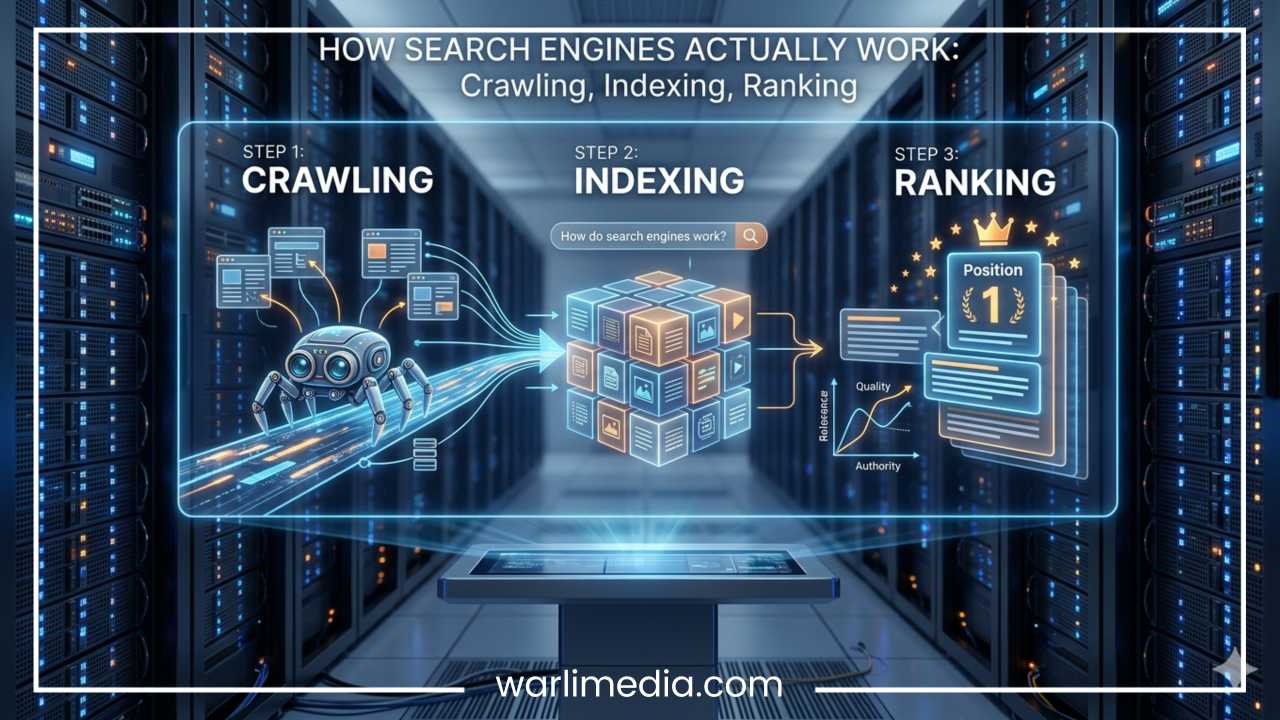
The journey a web page takes to get into this database follows a highly regulated pipeline: crawling, rendering, parsing, and storing.
First, discovery begins with crawling. Search engines deploy automated software programs called web crawlers, spiders, or bots. These crawlers systematically discover web pages by tracking hyperlinks from known pages to new ones, as well as by reading structured XML sitemaps submitted by webmasters.
Once a crawler arrives at a URL, it downloads the page’s HTML source code. In modern search engine architectures, the pipeline immediately moves to rendering. The search engine uses a headless browser system to execute JavaScript, CSS, and structural code, assembling the page exactly as a human user would see it on a desktop or mobile device.
After rendering, the parsing engine takes over. It analyzes the visual structure, layout, text content, metadata, images, and internal or external links. The engine evaluates the semantic meaning of the words, cataloging the concepts covered on the page. Finally, if the page meets the search engine’s structural and quality thresholds, it is written into the global index database.
Being indexed means a web page has cleared all technical hurdles and has achieved official eligibility to appear in public search results. It has been validated as a legitimate, accessible piece of the web.
However, it is vital to realize that indexing carries absolutely no performance guarantee. A page can reside perfectly within Google’s index database while simultaneously failing to generate a single impression or click. It exists in the system, but it remains invisible to the public because it sits far down in the dark corners of the database, uncalled by any common search queries.
Digital marketers can easily track and verify their indexing status using specialized tools. Within Google Search Console, the “Indexing” or “Pages” report offers an explicit view of a domain’s status. It separates URLs into two clean categories: “Indexed” and “Not Indexed.”
If a page is marked as indexed, it confirms that Google knows the page exists and has successfully processed its content. If a page falls into the non-indexed category, the tool usually outlines specific technical barriers preventing its storage.
Read: What is Inbound Marketing?
Several common indexing issues routinely block pages from entering the database:
Noindex tags: The presence of a
meta name="robots" content="noindex"tag in the HTML header explicitly instructs the search engine crawler to drop the page and exclude it from the database.Robots.txt blocking: A disallow directive within the site’s root
robots.txtfile acts as a barrier, forbidding crawlers from visiting specific directories or URLs entirely.Crawl errors: If a server experiences persistent 5xx errors or if a URL returns a 404 “Not Found” status code when the bot visits, the indexing pipeline collapses instantly.
Duplicate content: If a search engine determines that a page is a near-identical copy of an existing page already stored in its index, it will choose to ignore the duplicate to conserve storage space and processing efficiency, designating the original page as the canonical version.
The ultimate takeaway for this phase of search engineering is simple: Indexing equals eligibility to appear in search results. Without it, your content does not exist to the search engine.
Read: Marketing – What Makes an Effective Message?
What is Ranking?
Ranking is the strategic, algorithmically driven process of assigning specific positions to web pages within search results for a distinct user query. While indexing is a binary condition—a page is either stored in the database or it is not—ranking is highly variable, dynamic, and fluid. It represents the relative prominence and visibility of an indexed page in response to what someone types into a search box.
A foundational truth of search engine optimization is that ranking is entirely query-dependent. A web page does not simply possess a generic “good rank” on its own merits across the whole internet. Instead, it ranks for individual keywords, phrases, and semantic concepts.
The exact same URL can comfortably occupy the number one spot for a highly specific, long-tail keyword phrase, sit halfway down page three for a broader industry term, and fail to appear in the top one hundred results for a highly competitive head keyword. Ranking is an ongoing, real-time calculation that evaluates how perfectly a page’s content solves a specific user’s immediate intent.
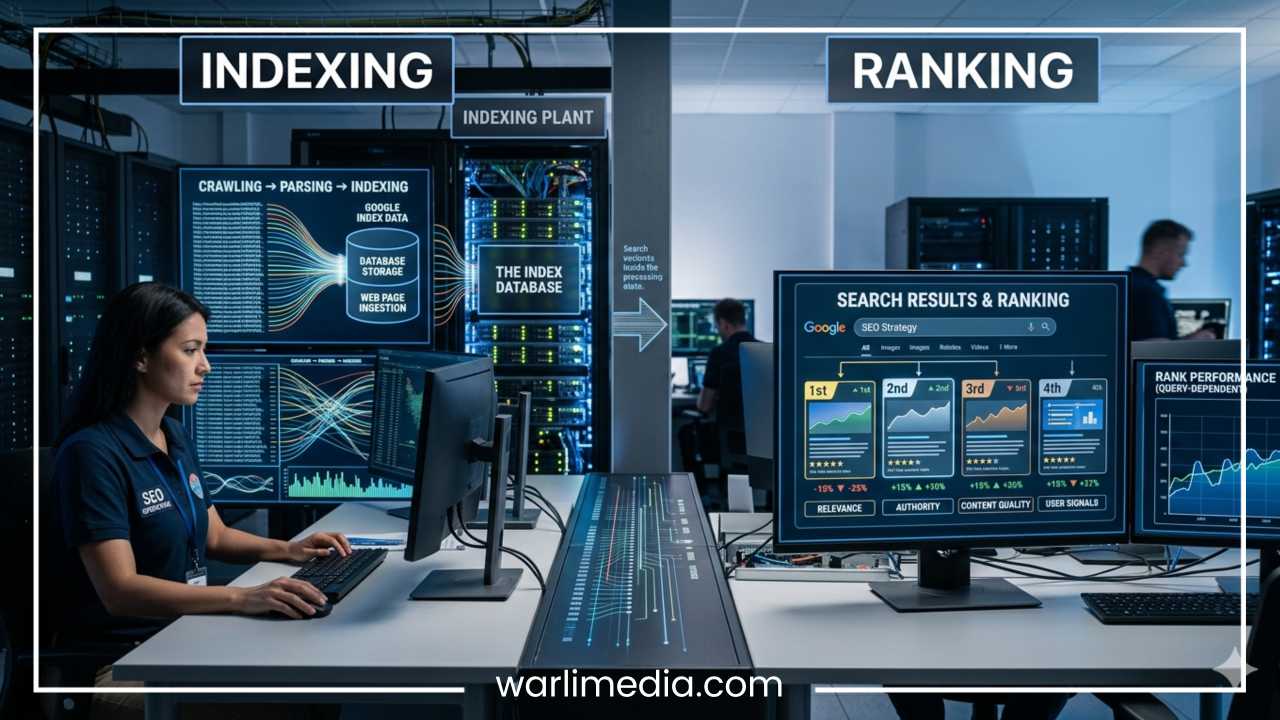
When a user submits a query, search engine algorithms evaluate hundreds of different ranking signals to filter the billions of indexed pages down to a definitive, ordered list on the Search Engine Results Page. These signals generally fall into four core pillars:
Relevance: The algorithm checks how accurately the topical content of the indexed page matches the intent behind the query. It looks at keyword placement, contextual synonyms, and semantic depth to ensure the page directly answers the user’s implicit question.
Authority: Search engines measure authority by analyzing the link graph of the internet. Backlinks from independent, high-quality, and topically relevant websites act as digital votes of confidence. A page backed by strong editorial links carries higher authority and naturally secures a higher position.
Content Quality: Algorithms assess the structural integrity, originality, and comprehensiveness of the writing. Content that demonstrates deep first-hand expertise, provides unique data, and avoids low-value fluff is prioritized over generic summaries.
User Experience Signals: Technical performance factors heavily into ranking algorithms. Pages that load fast, exhibit visual stability, adapt cleanly to mobile viewports, and provide secure HTTPS connections are systematically elevated over sluggish, poorly optimized destinations.
The ultimate display of these calculations is the Search Engine Results Page. The visual geography of a search page dictates the actual business value of a rank. Securing a position in the top three organic slots yields massive visibility and traffic, whereas ranking at the bottom of page one or anywhere on page two delivers negligible visibility, as very few users ever scroll or click past the initial fold.
An example of this dynamic nature can be seen in a comprehensive guide written about commercial real estate investment. The page may be perfectly indexed by the search engine. Because the content contains a deep breakdown of “triple net lease tax implications,” it may instantly rank number one for that specific, complex long-tail query.
However, if a user types the broad phrase “real estate,” that same page will be buried thousands of results deep because it lacks the universal authority and generalized intent required to compete for such a massive keyword. The key takeaway here is clear: Ranking equals visibility and position. It is the real-world manifestation of competitive performance.
Key Difference Between Indexing and Ranking
To fully grasp the architecture of search engine optimization, one must isolate the unique properties that separate indexing from ranking. While they are bound within the same software ecosystem, their operational goals, execution phases, dependencies, and levers of control are fundamentally distinct.
The core distinction lies in the separation between storage and evaluation. Indexing is an internal administrative process focused on population and data management. Its objective is to build an exhaustive, well-structured inventory of the digital world.
Ranking, on the other hand, is a public-facing evaluative process focused on curation and competition. Its objective is to filter that massive inventory down to the absolute finest selections, ordering them in a way that provides maximum utility to a human user.
The following table provides a structural breakdown of how these two processes differ across their primary operational dimensions.
| Operational Dimension | Indexing | Ranking |
| Primary Purpose | Storing and organizing web pages within a searchable database. | Determining the specific order and position of pages for a query. |
| Process Stage | Pre-computation phase (happens continuously in the background). | Real-time execution phase (happens instantly when a user searches). |
| Core Dependency | Technical accessibility, crawlability, and server health. | Relevance, link authority, quality depth, and user experience. |
| Control Factors | Clean HTML, proper tags, sitemaps, and robots.txt rules. | Content optimization, link building, and site performance. |
| Nature of Status | Binary state (the page is either in the index or out of it). | Continuous spectrum (positions fluctuate from numbers 1 to 100+). |
| Scope of Execution | Applied to individual URLs globally independent of keywords. | Applied strictly in direct response to a specific user keyword or intent. |
An important architectural insight that every digital strategist must memorize is this asymmetric relationship: All ranking pages are indexed, but not all indexed pages rank.
Inclusion within the index is a mandatory prerequisite for ranking. If a search engine has not parsed your URL and committed its data to its storage drives, the ranking algorithms will never even have the opportunity to evaluate its worth.
However, passing the technical gate of indexing does not earn any special favoritism from the ranking system. The index is a level playing field of trillions of pages; earning a spot inside the database simply grants you entry into the stadium. Winning the game requires surviving a completely separate set of strict algorithmic rules.
How Indexing and Ranking Work Together
Though indexing and ranking operate via separate programmatic logic, they are linked components of a single operational conveyor belt. A search engine cannot rank what it has not indexed, and it has no reason to index what it cannot safely discover. For a piece of content to successfully capture organic traffic, it must travel through a sequential step-by-step flow.
The process begins with crawling, where bots physically request and download the raw code of a URL. The data flows immediately into the indexing stage, where the rendering and parsing infrastructure processes the content, evaluates its fundamental structure, and writes it to the database index.
Once safely nested inside the index, the page sits in a state of constant readiness. The final stage is ranking. When a live user typing a query triggers the system, the ranking algorithms pull the page from storage, measure its contextual signals against competitive URLs, and display it in a specific position on the search results page.
[Crawling] ---> [Indexing] ---> [Ranking]
(Discovery) (Storage) (Ordering)
Understanding this sequence reveals why indexing alone is an empty victory that does not guarantee traffic. Indexing is a passive, structural success. It proves your website’s engineering is sound enough to allow a bot to read it, but it says nothing about the commercial or educational value of your content. You can have a website with ten thousand indexed pages that generates zero organic visitors because every single one of those pages ranks on page five or deeper for their target keywords.
To visualize how these mechanics cooperate over time, consider the lifecycle of a newly published, comprehensive blog post analyzing corporate productivity frameworks:
Day 1 (Publishing): The writer clicks publish. The URL goes live on the internet. At this precise moment, the page is neither indexed nor ranking. It is invisible to search engines.
Day 2 (Discovery and Crawling): The site’s XML sitemap automatically updates. A search crawler reads the sitemap, discovers the new URL, fetches the HTML, and passes it to the rendering engine.
Day 3 (Indexing Secured): The search engine parses the rendered text and decides the content is unique and well-structured. It commits the URL to its storage index. The page is now officially indexed and technically eligible to rank.
Week 2 (Initial Ranking Position): The ranking algorithm begins testing the page for minor, highly specific long-tail queries like “corporate productivity framework comparison guide.” The page secures a baseline position on page three of the search results.
Month 3 (Algorithmic Promotion): Over time, other industry websites read the guide and begin creating organic backlinks to it. The site’s overall authority rises, and users clicking the link spend a long time reading the content. The ranking algorithm registers these positive authority and experience signals, steadily promoting the URL from page three to page one, positioning it in the top three organic slots for high-volume keywords.
This lifecycle demonstrates that while technical SEO ensures a page successfully achieves indexing, a combination of content optimization, link acquisition, and user engagement is required to drive the page upward through the ranking system.
Common Problems: Indexed but Not Ranking
One of the most disheartening scenarios an digital marketer can face is a website filled with pages that are perfectly indexed according to search tools, yet fail to generate any meaningful traffic or visible search placement. This situation indicates that your technical foundation is completely sound, but your execution falls flat when evaluated by competitive ranking filters.
When a site is indexed but fails to rank, the root causes are typically found in the following strategic areas:
Thin Content: Pages that contain very little text, or provide generic, surface-level information without real substance, fail to satisfy quality algorithms. If a page offers nothing more than a couple of brief paragraphs that could be found on a thousand other websites, the ranking engine has no incentive to showcase it.
Low Authority and Lack of Backlinks: The keyword space you are targeting may be highly competitive. If established websites with massive link profiles occupy the top positions, a page with zero incoming external links will struggle to break through, regardless of its writing quality.
Poor Keyword Targeting: The content may be written using internal corporate jargon or phrases that real people never actually type into a search box. The page might technically match the concept, but because it misses the precise language used by searchers, it fails to connect with real search queries.
Content and Search Intent Mismatch: This occurs when the format or angle of your content does not align with what users are looking for. For example, if a user searches for a quick calculator tool, and your page provides a five-thousand-word historical essay instead, the ranking algorithm will drop your page because it fails to satisfy the user’s immediate operational intent.
Canonicalization Problems: If your site features multiple pages covering nearly identical topics, the ranking algorithm may experience confusion, splitting ranking signals across those URLs or suppressing them altogether in favor of outside competitors.
Algorithmic Suppression: If a page exhibits signs of keyword stuffing, contains intrusive pop-up ads that ruin the mobile experience, or shows patterns of low-quality AI generation without human editorial oversight, search algorithms may actively suppress its visibility.
To diagnose and resolve a situation where content is stuck in the index without ranking, you must follow a methodical diagnostic approach.
First, navigate to your search analytics tools and inspect the exact queries your page is generating impressions for. Look for low-threshold keywords where the page might be showing up on pages four or five. This tells you exactly how the search engine is currently categorizing your content’s topic.
Next, perform an objective competitive analysis. Search your target keywords in a private browser window and carefully study the top three ranking results. Analyze their structural depth, the specific subtopics they address, their user experience design, and their interactive elements. Compare your page directly to these leaders.
Are they answering questions that you completely ignored? Do they feature original imagery, diagrams, or calculators that make their page inherently more useful?
Once you isolate these gaps, focus your energy on improving content depth. Rewrite thin sections to inject genuine first-hand expertise, update outdated facts, clear out layout distractions, and build internal links from other high-authority pages on your own domain to transfer internal page power directly to the struggling URL.
Common Problems: Not Indexed at All
When content is entirely absent from a search engine’s index, you are facing a technical execution failure. This is a critical issue because it prevents your content from even entering the competitive arena. No amount of high-quality writing, keyword optimization, or external link building can save a page that suffers from an indexing block.
The primary culprits behind a complete lack of indexing are usually structural or administrative errors:
Accidental Noindex Tags: This frequently occurs during website migrations or redesigns. Developers often apply a global
noindexdirective to a staging site to keep it hidden during production, and then accidentally leave that tag live in the code code when pushing the site to the live public server.Robots.txt Blocking: A site’s
robots.txtfile may contain overreaching disallow rules that inadvertently lock search crawlers out of key content directories, cutting off entire sections of the site from discovery.Crawl Budget Exhaustion: For massive websites containing tens of thousands of pages, search engine bots allocate a limited amount of time and resources per visit. If the site suffers from slow server response times, convoluted navigation pathways, or infinite redirect loops, the bot will exhaust its allowed budget and leave before discovering or processing deeper pages.
Orphan Pages: An orphan page is a URL that exists on a server but contains zero internal incoming links from any other page on the website. If a crawler cannot navigate to a page through standard site links, and it is missing from the sitemap, it remains undiscovered.
Persistent Server Errors: If a hosting provider experiences regular downtime or performance drops, search bots attempting to crawl the site will hit 5xx server errors, causing them to abandon the URL and remove any existing temporary records from the index queue.
Resolving these indexing blocks requires targeted technical fixes. The baseline tool for this work is the URL Inspection tool within Google Search Console. By pasting the problematic URL into the tool, you can run a live test that simulates a crawler visiting the page in real time. The resulting report will explicitly state whether the page is blocked by a robots.txt rule, a noindex tag, or a delivery failure.
[Discover URL Issue] ---> [Run URL Inspection] ---> [Identify Block] ---> [Apply Fix]
To systematically fix a non-indexed site, verify that your XML sitemap is accurate, updated, and correctly submitted directly through search webmaster tools. Next, review your internal linking architecture. Ensure that every new or important page is linked directly from related category pages or high-traffic posts, giving crawlers an easy path to follow.
If the live inspection tool reveals a noindex directive, access your Content Management System settings or edit the source HTML header to completely purge the tag. Finally, consult with your hosting provider to verify that server response times are optimal, ensuring that search engines can easily fetch your code without hitting technical timeouts.
SEO Strategy Implications
Distinguishing between indexing and ranking dictates how an SEO roadmap is constructed, prioritized, and executed. A sophisticated search strategy approaches these two mechanics as separate stages of growth, treating technical optimization as the baseline foundation and content authority as the primary engine for visibility.
When designing an operational workflow, technical SEO must always be deployed to secure stable indexing before any resources are spent trying to optimize ranking factors. It is a waste of time and money to hire premium writers, craft brilliant editorial pieces, and invest heavily in digital PR campaigns if your website code contains broken render paths, messy redirect chains, or accidental blocking scripts that keep search engine spiders from reading the work.
Technical optimization creates a reliable digital container; once that container is proven to be accessible, you can shift your focus to filling it with competitive value.
This operational reality separates search marketing into two distinct fields of focus:
Technical SEO Ensures Indexing: This discipline deals with the structural side of the web. It involves managing server response times, setting up correct canonical tags, building clean XML sitemaps, optimizing JavaScript rendering budgets, fixing broken redirect loops, and ensuring a secure HTTPS configuration. The target user for technical SEO is the search engine crawler. Its success metric is a high ratio of indexed pages relative to total created URLs.
Content and Authority Ensure Ranking: This discipline focuses on the human element and competitive dynamics. It involves conducting deep keyword intent research, producing comprehensive informational content, optimizing on-page formatting, improving mobile interface speed, and building high-value editorial links from trusted industry publications. The target user here is the flesh-and-blood human searcher. Its success metrics are average position rankings, organic impressions, click-through rates, and on-site conversions.
A balanced SEO roadmap structures its priorities based on this hierarchy of needs. If a site audit reveals that a critical section of product pages is missing from search results due to a crawl error, all content writing initiatives should be paused. The technical block must be cleared first.
Once the search engine tools confirm the pages are indexed and eligible, the marketing team can execute content enhancements, enrich target keyword optimization, and pursue link acquisition to drive those newly eligible URLs upward into premium ranking positions.
Real-World Scenarios
To move these concepts from theoretical architecture into practical execution, let us look at three distinct real-world scenarios that highlight how indexing and ranking diverge in daily business operations.
Scenario A: The Disconnected Blog Post
An established corporate software company publishes an incredibly deep, original research report tracking remote work productivity trends. The marketing team reviews their analytics two weeks after launch and notices the post has received exactly zero organic visits from search engines.
The team panics, assuming their content quality is poor, and immediately begins planning a full rewrite. However, a quick check of the URL in an indexing inspection tool reveals that the page is completely indexed. The issue is not technical eligibility; it is competitive rank performance.
Because the post targeted the massively competitive head keyword “remote work,” it was assigned an initial ranking position on page twelve of the search results, where no human user could ever find it. The correct strategic solution here is not a technical fix or a complete rewrite, but rather targeted on-page adjustments to weave in lower-competition long-tail keywords, combined with an internal link building push from high-authority pages on the company’s main blog.
Scenario B: The E-Commerce Launch Drop
An established retail website launches a brand-new product category featuring fifty newly designed leather boots. They ensure the text descriptions are written beautifully, target high-intent keywords, and feature high-resolution imagery.
A month passes, and none of the fifty new product pages appear anywhere in search results for any queries, including their exact brand names. The team checks their rank tracking software, which shows nothing but blank entries.
Upon running a diagnostic crawl, the team discovers that when developers pushed the new product template live, they accidentally cloned a metadata header from an internal development environment that contained a hardcoded noindex tag. Here, the pages were entirely blocked from entering the search engine database. The content optimization was great, but the technical barrier made it irrelevant.
Once the developers removed the noindex tag and resubmitted the product sitemap, the search engine indexed the pages within forty-eight hours, and they instantly captured top-three rankings for their unique branded keywords.
Scenario C: The Domain Migration Crawl Trap
A fast-growing media website transitions from an old domain name to a brand-new corporate domain. They carefully set up one-to-one 301 redirects for all five thousand articles to ensure a smooth transition.
Two months after the move, they notice their organic traffic has dropped by sixty percent. Upon inspecting their webmaster dashboard, they discover that while their old URLs have been dropped from the index, only fifteen hundred of the new domain URLs have been successfully processed and indexed.
The site has fallen into a crawl budget trap. Because the new server responds slowly under heavy bot traffic, the search engine spiders are timing out before completing the crawl of the remaining thirty-five hundred redirected pages. The unindexed pages cannot rank, causing a massive drop in total site visibility. The fix requires moving the new domain to a high-performance cloud hosting architecture to reduce server response times, allowing the search bots to quickly process the remaining index queue and restore the site’s previous ranking positions.
Final Thoughts
Navigating the search landscape requires maintaining a crystal-clear distinction between indexing and ranking. They are not competing philosophies, but rather two consecutive chapters in a web page’s lifecycle. Indexing is an internal, technical structural victory focused entirely on database inclusion and accessibility. Ranking is an external, market-facing competitive victory focused completely on content relevance, authority, and user position.
To keep your search strategy sharp, always remember this basic operational framework: Indexing means your content can be found by the system, while ranking dictates how well your content performs for a user.
When your website encounters organic performance issues, avoid taking a guessing-game approach. Use your diagnostic tools to isolate the exact step where the breakdown occurs.
If a page is missing from the index, drop the content editing and call a technical developer to clear away code-level blocks. If a page is safely stored within the index but buried deep in search results, shift your focus to content depth, user intent alignment, and link authority. By mastering the distinct mechanics of indexing and ranking, you protect your digital marketing from wasted effort and build an SEO framework designed for long-term growth.
Frequently Asked Questions
Why is my website indexed but not showing up in Google search results?
This usually happens because of low ranking performance rather than an indexing fault. If Google Search Console confirms your URL is indexed, the page is technically eligible to appear, but its ranking signals (such as relevance, content depth, or domain authority) may be too weak to outshine competitors. As a result, the page is pushed back to deep search results pages where it receives no visibility.
How long does it take for Google to index a new page after publishing?
For an established website with healthy crawl activity, indexation can take anywhere from a few hours to a few days. For brand-new websites with low link authority, it can take up to several weeks for search crawlers to discover, render, and store the new URLs in their database. You can accelerate this pipeline by manually submitting the URL through the Google Search Console Inspection tool.
Can a page rank on Google if it has a noindex tag in the HTML?
No, a page cannot rank if it contains a noindex tag. The noindex directive explicitly tells search engines not to store the URL in their database. Because indexing is a mandatory prerequisite for ranking, a non-indexed page is completely excluded from the algorithmic evaluation process and will never appear on a search engine results page.
What is the difference between a URL redirect and an indexed page?
A URL redirect (like a 301 or 302 redirect) is a server instruction that automatically forwards a user or search bot from one address to another. A redirect does not get indexed as content. Instead, the search engine follows the redirect path and indexes the final destination URL, provided that destination page is accessible and meets quality standards.
How do I check if my blog post is cached and indexed correctly?
The most reliable method is to paste the exact URL into the URL Inspection tool inside Google Search Console, which provides the live database status of the page. Alternatively, you can perform a footprint search in Google by typing site:[yourdomain.com/your-page-url](https://yourdomain.com/your-page-url) into the search bar. If the page appears in the results, it is officially indexed.
Why did my page drop in ranking if it is still indexed?
A sudden drop in position while maintaining indexation means your technical foundation remains intact, but the algorithmic evaluation of your competitive value has shifted. This can be caused by a core search algorithm update, an aggressive push from a competitor updating their content, a loss of high-quality backlinks, or an intentional penalty due to declining user experience metrics on your site.