
The Role of AI in Modern Search: How Artificial Intelligence Is Transforming Search Engines
Why Search Is Being Rebuilt by AI
For decades, human interaction with the internet relied on a simple, unspoken contract: users provided fragmented keywords, and search engines returned a list of blue links. This was the era of keyword matching. If a user wanted to find the best way to fix a broken pipe or understand a complex macroeconomic theory, they had to break their thought process down into rigid, disconnected terms. The burden of synthesis fell entirely on the human. The user had to click through multiple websites, cross-reference data points, filter out spam, and piece together their own answers.
Today, this foundational contract is undergoing a profound transformation. Search is being fundamentally rebuilt from the ground up, shifting from simple keyword matching to deep intent understanding. Artificial intelligence has fundamentally changed what we expect from information retrieval. We are moving rapidly away from a paradigm where search engines merely point to where information lives, and toward an era where systems synthesize, contextualize, and deliver direct answers. Search is transforming from a static query-and-response tool into an ongoing, fluid conversation.
In the traditional landscape, platforms developed by Google and Microsoft dominated the ecosystem by perfecting the art of indexing the web and ranking it based on popularity and textual relevance. While these systems were incredibly powerful, they fundamentally required users to speak the language of machines. Generative AI has reversed this dynamic. Now, machines are learning to speak the language of humans. This shift has altered user expectations permanently. Users no longer want to browse a digital library; they want to consult an expert advisor who can instantly read millions of pages and provide a cohesive, tailored response.
Read: Why Taking a Break Could Make Your Career
Evolution of Search: From Keywords to Intelligence
To appreciate the scale of the current AI revolution, it is essential to understand the historical stages that brought the web to this point. The earliest iterations of search in the 1990s were little more than digital directories. Human editors manually categorized websites into taxonomies, meaning discovery was entirely dependent on human curation. As the web grew exponentially, this manual approach became unsustainable, giving rise to the first automated search engines that relied heavily on raw keyword frequency.
The true breakthrough came with the keyword and PageRank era. Google revolutionized information retrieval by looking beyond the words on a page to the structural relationships of the web itself. By analyzing how websites linked to one another, PageRank treated hyperlinks as democratic votes of confidence. The more authoritative websites linked to a specific page, the higher that page ranked. Yet, even during this era of massive web growth, the underlying mechanics remained bound to literal string matching. If a user typed a specific phrase, the engine looked for pages containing those exact characters, often leading to search engine optimization tactics like keyword stuffing.
As the web grew more complex, search engines began introducing sophisticated machine learning ranking systems. Rather than relying on rigid, human-written heuristics, engineers trained algorithms to dynamically weight hundreds of different ranking signals simultaneously. Platforms like Google introduced large-scale ranking algorithms to better handle ambiguity, while Microsoft heavily focused on integrating machine learning and later AI copilots into its search architecture to gain a competitive edge. These iterative improvements laid the groundwork for modern intelligence, moving search away from static mathematical formulas and toward fluid, adaptive models capable of parsing human nuance.
Read: Ten Number Plates That Show Your Business Has Really Taken Off
Traditional Search Mechanics
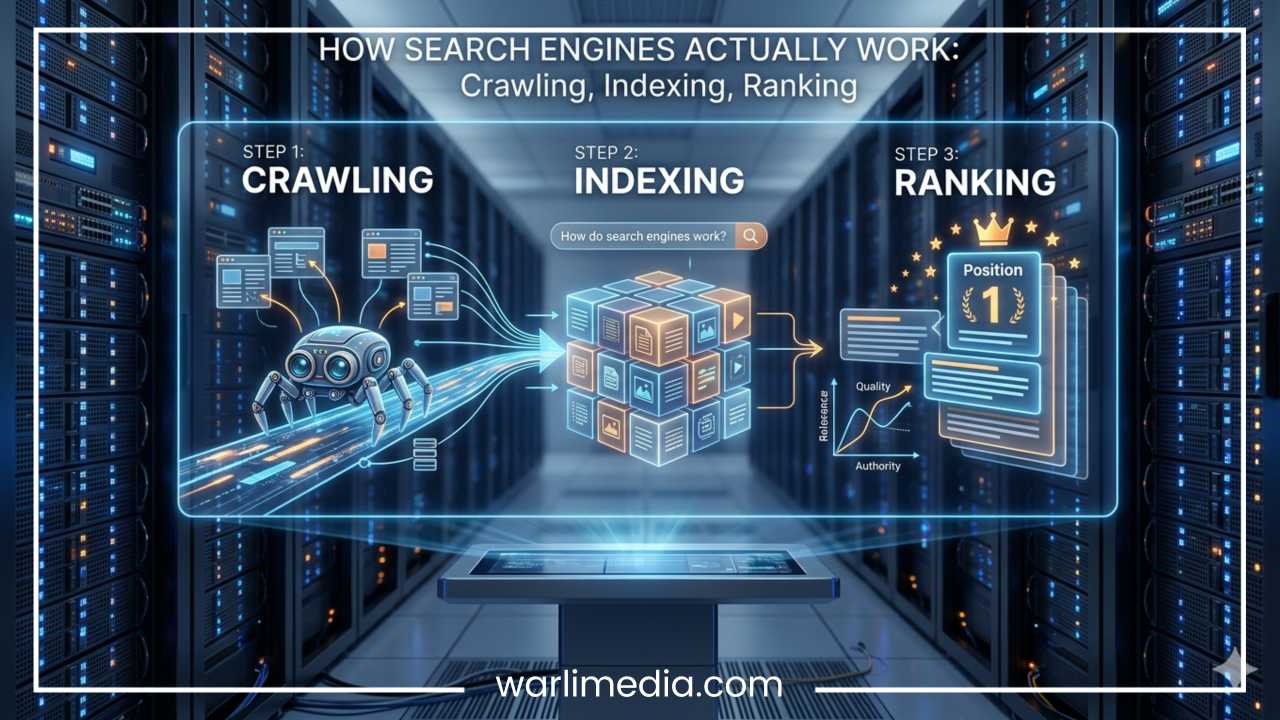
To understand how artificial intelligence changes the paradigm, one must first look at the mechanics of classic search systems. Traditional search operates through a three-step pipeline: crawling, indexing, and ranking.
First, automated bots known as web crawlers or spiders continuously traverse the internet by following hyperlinks from page to page. These crawlers download the textual content, code, and metadata of every accessible website they encounter. Second, this raw data is processed and stored in a massive, structured database called an inverted index. Think of an inverted index as the index at the back of a textbook, but on a global scale. It lists every unique word ever found on the web, followed by a list of every specific webpage where that word appears.
When a user submits a query to a traditional search engine, the system does not scan the live internet; it queries this pre-built index to find pages containing matching terms. This keyword matching process is incredibly fast but fundamentally literal. To determine which matching pages to display first, the system applies link-based ranking signals such as:
Authority: The volume and quality of external websites linking to the page.
Relevance: How frequently and prominently the queried keywords appear within the document text.
Freshness: How recently the page was published or updated, particularly for news-oriented queries.
This structural approach to retrieval is not unique to global web search engines. Enterprise applications and internal databases have long relied on systems like Elasticsearch to power structured retrieval outside web search. Elasticsearch and similar technologies use text-matching metrics to score documents based on term frequency and document frequency. While these classic systems are remarkably efficient at parsing massive structured data sets, they remain inherently blind to meaning. If a user searches for “canine care tips” and a document only contains the words “dog health advice,” a purely traditional keyword system will fail to connect the two, highlighting the fundamental limitation of how search used to work.
Read: Why CEOs Put Expensive Paintings in Their Office?
The AI Shift: Machine Learning in Ranking
The integration of artificial intelligence into search did not happen overnight with the advent of large language models. Instead, it began years earlier when search engines started incorporating machine learning directly into their core ranking pipelines. This marked the transition from systems governed by rigid, human-engineered rules to systems capable of learning from data.
The first major leap came with the introduction of learning-to-rank systems. In a classic search setup, human engineers manually adjusted the weights of different ranking factors—deciding, for instance, whether a page’s title match was more important than its backlink count. Learning-to-rank systems replaced this manual guesswork with supervised machine learning. By training on vast datasets of queries and human-evaluated results, these algorithms automatically discovered the optimal balance of signals for different types of queries, significantly improving search quality across millions of edge cases.
Following this, the introduction of neural ranking models allowed search engines to evaluate the relationship between queries and documents at a conceptual level. Rather than analyzing text as isolated strings of characters, deep neural networks began processing the underlying patterns within sentences.
Simultaneously, search engines began heavily weighing behavioral signals, such as:
Click-Through Rates: How often users select a specific result for a given query.
Dwell Time: The amount of time a user spends on a destination page before bouncing back to the search results.
Search Refinements: Whether a user immediately types a new query, signaling dissatisfaction with the initial results.
By factoring in these real-time human behaviors, search engine ranking pipelines transformed from static, rule-based algorithms into highly adaptive networks. Search engines stopped being passive directories and became active observers of human intent, continuously tuning their outputs based on collective user behavior.
Semantic Search and Embeddings
The true bridge between traditional keyword retrieval and modern artificial intelligence is the rise of semantic search. Semantic search is the practice of understanding the actual meaning and context of a query, rather than simply looking for identical character strings. This breakthrough is powered entirely by vector embeddings.
In an AI-driven search system, mathematical models convert words, phrases, and entire web documents into high-dimensional vectors—numerical representations of meaning plotted within a complex mathematical space. In this vector space, words that share conceptual similarities are placed close to one another, regardless of whether they spell things similarly. For instance, the vectors for “automobile,” “car,” and “electric vehicle” will cluster tightly together in the mathematical model because they share a deeply related semantic context.
[Traditional Keyword Search] ---> Looks for exact word matches (e.g., "car")
[Modern Semantic Search] ---> Matches conceptual meanings via vectors (e.g., "car" = "vehicle")
This mathematical approach allows for context-based retrieval instead of literal keyword matching. When a user inputs a query, the search engine converts that query into a vector and calculates which documents in its database possess the closest vector trajectories. This enables the engine to prioritize meaning over exact words.
If a user asks, “What is the name of that movie where the dreams happen inside other dreams?”, a semantic search engine can easily return “Inception.” A traditional keyword search engine would struggle with this query because the word “Inception” does not appear in the prompt, and the word “movie” is too generic to yield helpful results. Semantic search effectively solves the problem of human expression, allowing users to search naturally, colloquially, and conceptually.
Conversational and Generative Search
The most disruptive shift in contemporary information retrieval is the transition into conversational and generative search. For the first time since the invention of the web, search is changing from a structural retrieval process into a dynamic dialogue. Users no longer receive a fragmented index of destinations; they receive synthesized, coherent, and direct answers generated in real time.
This paradigm shift was catalyzed by the widespread adoption of ChatGPT as a conversational interface. It fundamentally rewired what users expect when they seek information online. Instead of inputting a query and opening five different browser tabs to read and synthesize disparate viewpoints, users realized that an AI system could perform that cognitive labor for them. OpenAI acted as a massive driver of generative AI models, proving that natural language processing could handle complex, multi-step prompts that traditional search systems could never parse.
Following this breakthrough, AI-native search engines like Perplexity AI emerged to define a entirely new category of information retrieval. Unlike traditional models that rely on static training data or traditional engines that rely on simple indexing, these native systems combine web retrieval with generative power. They execute search queries behind the scenes, pull relevant information from various live sources, and instantly synthesize those findings into a clear, cited narrative response.
Traditional Workflow:
Query ---> Search Engine ---> List of Links ---> User Clicks Link 1 ---> User Clicks Link 2 ---> User Synthesizes Answer
Generative Workflow:
Query ---> AI Search Engine ---> Real-Time Web Retrieval ---> Multi-Source Synthesis ---> Final Answer Delivered
As a result, modern users expect comprehensive synthesis, not just raw retrieval. They expect a search system to understand multi-part conditions, such as: “Compare the nutritional profiles of Mediterranean and ketogenic diets, highlight the pros and cons for endurance athletes, and provide a sample three-day meal plan without dairy.” A traditional link-based system fails completely here, but a generative search platform handles it gracefully by dynamically constructing a unique answer from multiple primary sources.
AI in Indexing, Crawling, and Content Understanding
While the generative user interface is the most visible element of modern search, AI is quietly transforming the back-end infrastructure of the web. The way search engines discover, process, and clean data before it ever reaches a user has been completely revolutionized by machine learning.
Traditional web crawlers were largely blind to content quality; they simply pulled text and HTML structures indiscriminately. Today, AI models are deeply integrated into the crawling process to analyze page intent dynamically. This allows engines to determine whether a newly discovered page offers genuine informational value, serves a transactional purpose, or exists merely to game search algorithms.
Furthermore, AI has significantly advanced content classification and quality control by improving:
Spam Detection: Machine learning classifiers evaluate patterns of text generation, hidden links, and deceptive redirects far more effectively than old signature-based systems.
Duplicate Detection: Instead of looking for identical paragraphs, semantic AI identifies when thousands of pages are spinning the exact same information in slightly different words, allowing the indexer to prioritize the original source.
Structural Parsing: AI can identify the core components of a page, separating the main article text from peripheral noise like sidebar advertisements, navigation menus, and footers.
By reading web pages more like human beings do, search engines can filter out low-value clutter at the indexing stage. This ensures that only high-quality, semantically rich information is preserved, saving massive amounts of computational power during the retrieval phase.
Personalization and Context-Aware Search
One of the defining features of modern search is that there is no longer a single, objective set of results for any given query. AI has turned search into an individualized experience by analyzing a massive array of contextual signals in real time.
When a user enters a query, an AI-driven search engine looks far beyond the text box to understand the broader situation surrounding the search. It instantly evaluates the user’s geographic location to deliver hyper-local relevance, whether they are looking for a nearby restaurant or checking local tax regulations. It tracks immediate search history to understand the intent behind sequential queries; for instance, if a user searches for “python” immediately after searching for “programming languages,” the AI knows to filter out results about snakes.
Additionally, device types, time of day, and historical browsing behaviors are processed to tailor the output. This deep personalization ensures that a software developer searching for “cookies” on a laptop receives technical documentation on web tracking, while a home baker searching for “cookies” on a mobile device receives dessert recipes. By turning search into a situational assistant, AI maximizes relevance while minimizing the time users spend filtering out unhelpful contexts.
Multimodal Search
Human communication is inherently multi-sensory, yet traditional search confined users to a strictly text-based medium. AI has dissolved these text boundaries by introducing multimodal search, allowing systems to process, understand, and connect diverse forms of media seamlessly.
Voice search was the early pioneer of this shift, moving search engines from parsing formal keywords to understanding natural, conversational speech patterns. Today, computer vision has unlocked advanced image search capabilities. Users can take a photo of an unknown plant, a broken machine part, or a piece of clothing, and the AI can analyze the visual features to identify the item and locate relevant information or purchase options instantly.
The current frontier of multimodality is deep video understanding. Historically, search engines could only index videos by reading their titles, descriptions, and user-generated tags. Modern AI models can watch video files, transcribe the spoken audio, recognize objects and text within the video frames, and understand the conceptual narrative over time. This means a search engine can direct a user to the exact timestamp within a two-hour lecture where a specific topic is discussed, making the vast repository of online video content as searchable as text.
SEO in the Age of AI Search
The shift toward intelligent, generative search systems has caused a massive disruption in the digital marketing and web publishing industries. For decades, Search Engine Optimization (SEO) was dominated by keyword optimization, backlink building, and technical site structuring designed to appeal to mechanical crawlers. Today, the industry is undergoing a massive shift from traditional SEO to AEO, or Answer Engine Optimization.
+-------------------------------------+-------------------------------------+
| Traditional SEO Focus | Modern AEO Focus |
+-------------------------------------+-------------------------------------+
| Target Keyword Density | Conceptual Topic Authority |
| Meta Tags & H1-H3 Placements | Structured Schema Markups |
| Raw Click-Through Traffic | Inclusion in AI Summaries & Citations|
+-------------------------------------+-------------------------------------+
In this new environment, targeting individual keywords has lost its effectiveness. AI search engines prioritize topic authority and deep, comprehensive content over keyword frequency. Websites must focus on providing unambiguous, expertly authored answers to complex human questions. This requires a heavy reliance on clean, structured data that AI models can easily parse to verify facts, dates, and relationships.
The biggest challenge facing modern web creators is the rise of zero-click searches, driven by AI-generated summaries. When an AI search engine provides a complete, synthesized answer directly on the results page, users rarely feel the need to click through to the underlying websites. This reduces click-through rates for informational queries, forcing publishers to rethink their business models. To stay visible, modern web content must be authoritative and unique enough to serve as an indispensable source that the AI explicitly cites within its generated answers.
Challenges and Risks of AI Search
Despite its immense power, the integration of AI into search introduces significant risks and systemic challenges. The most pressing technical hurdle is the phenomenon of hallucinated or incorrect answers. Generative language models operate on probabilistic text generation, meaning they predict the most likely next words in a sentence based on patterns in their training data. Because they lack a native understanding of objective truth, they can confidently assert false facts, fabricate historical events, or misquote legal and medical documents, posing serious challenges for users seeking accurate information.
Another critical concern is the presence of bias in training data. If the underlying data used to train an AI model contains historical, cultural, or gender biases, the search system will inadvertently replicate and amplify those biases in its synthesized responses. This issue is compounded by a profound lack of transparency in AI ranking systems. Unlike traditional algorithms where engineers could trace exactly why a specific page ranked first, deep neural networks function as complex systems where the internal decision-making process is difficult to audit.
Furthermore, there are serious societal concerns regarding the over-reliance on generated summaries, including:
Information Echo Chambers: Users may accept a single synthesized perspective without ever encountering the diverse viewpoints present in the primary sources.
Economic Strain on Creators: If AI tools pull content from creators without driving traffic back to their sites, publishers may lose the financial incentive to create new content.
Erosion of Fact-Checking Skills: As users grow accustomed to instant answers, their inclination to cross-reference facts and evaluate source authority naturally declines.
Balancing the convenience of instant synthesis with the absolute necessity of source diversity and verifiable accuracy remains one of the greatest challenges for the next generation of search architecture.
Future of Search: Agentic and Proactive Systems
Looking forward, search is moving far beyond the boundaries of a text box or a passive question-and-answer tool. The next major evolution is the transition toward agentic and proactive systems. Search will no longer simply find information; it will act upon it.
Future search platforms will incorporate intelligent AI agents capable of executing complex, multi-step tasks across the web on behalf of the user. Instead of merely researching options for a vacation, a user will be able to instruct an agentic search assistant to find flights within a budget, locate a hotel that meets specific accessibility requirements, cross-reference options with personal calendar commitments, and complete the bookings autonomously.
[Passive Search] ---> "Show me hotels in Tokyo."
[Agentic Search] ---> "Find a hotel in Tokyo near a train station, book it for June 5-12, and add it to my calendar."
Concurrently, search will become increasingly predictive and proactive, anticipating user needs before an explicit query is ever typed. By securely analyzing a user’s current workflow, upcoming schedule, and habits, proactive systems will surface relevant data exactly when it is needed. For example, as an engineer sits down to debug a specific segment of code, their environment might automatically retrieve the relevant documentation or pull a recent patch note. In this future, search ceases to be an explicit destination or a discrete app; it becomes an ambient, intuitive assistant integrated directly into our digital workflows.
Final Thoughts: Search as an Intelligence Layer
The transformation of search marks a fundamental shift in our relationship with digital information. We are living through the end of information retrieval as a mechanical process of finding links, and witnessing its rebirth as a cognitive process centered on understanding human intent and delivering immediate, synthesized solutions.
Artificial intelligence has broken down the barriers between human thought and online data. By turning search into an always-present intelligence layer, AI allows us to interact with the entirety of human knowledge as if we were speaking to a single, infinitely knowledgeable assistant. As these technologies continue to evolve, the systems that connect us to the web will become more intuitive, helpful, and integrated into our daily lives, transforming search from a simple online tool into an essential extension of human thought.
Frequently Asked Questions
What is the difference between keyword search and semantic search?
Traditional keyword search looks for exact character matches between the user’s query and the words on a webpage. If you search for “automobile repairs,” a strict keyword engine might miss a highly relevant page that only uses the terms “car mechanics.”
Semantic search, on the other hand, focuses on intent and conceptual meaning. By transforming words into high-dimensional mathematical values called vector embeddings, semantic search maps out the relationships between ideas. This allows the search engine to understand that “automobile repairs” and “car mechanics” are conceptually identical, delivering highly relevant results even when exact words do not match.
How does generative AI change search engine optimization strategies?
Generative AI shifts the focus of digital marketing from traditional Search Engine Optimization (SEO) to Answer Engine Optimization (AEO). In the keyword era, optimization revolved around keyword density, specific meta tags, and building a high volume of backlinks to rank in a list of blue links.
With AI-driven search engines providing direct answers, optimization requires building deep topical authority. Content creators must focus on writing comprehensive, clear, and authoritative answers to multi-part user questions. Additionally, integrating structured schema markup is vital, as it allows AI models to easily crawl, parse, and verify your site’s facts, data points, and relationships for inclusion in their generated summaries.
Why do AI search engines hallucinate and provide false information?
AI search engines hallucinate because they are built on large language models that operate on probabilistic text prediction, not objective factual databases. When a user inputs a query, the model predicts the most statistically likely sequence of words to follow based on patterns it learned during training.
Because these models lack a native understanding of real-world facts or logic, they can create sentences that sound perfectly coherent, grammatically correct, and highly confident, yet are completely fabricated. While modern search tools attempt to mitigate this by anchoring the AI to live web search results, the underlying generative process can still misinterpret sources or blend conflicting data points incorrectly.
Will AI search engines completely replace traditional website traffic?
AI search engines are significantly altering web traffic patterns, particularly by increasing the number of “zero-click searches”—queries where the user gets their answer directly from the AI summary without clicking a link. Informational queries, such as quick facts, simple definitions, and basic comparisons, are seeing the steepest declines in click-through rates.
However, AI search is unlikely to completely replace website traffic. For deep research, transactional intents, complex troubleshooting, and nuanced entertainment, users still need to visit primary sources. To maintain traffic, web publishers must pivot away from low-value, easily summarized informational content and focus on creating original research, unique expert opinions, and highly interactive tools that AI summaries cannot easily duplicate.
What is multimodal search and how do I use it?
Multimodal search is the capability of an artificial intelligence system to accept, process, and understand multiple distinct types of input beyond standard typed text, including voice, images, and video.
In practice, a user can engage in multimodal search by uploading a photograph of a mystery plant to identify its species, speaking a conversational question aloud into a device, or searching for a specific concept contained inside a two-hour video file. The AI analyzes the visual features, auditory frequencies, or textual data simultaneously, bridging the gap between different media formats to find a unified answer.