What is a Knowledge Graph? A Complete Guide
Why Knowledge Graphs Matter
The digital universe is experiencing an unprecedented information explosion. Every second, enterprise systems, websites, applications, and smart devices generate astronomical amounts of data. Yet, for decades, organizations have faced a structural paradox: they are drowning in data but starving for actionable knowledge. Traditional data management systems are built to store information in rigid, isolated silos. They excel at processing isolated transactions, but they inherently struggle to understand the complex web of relationships, context, and nuance that characterizes the real world.
In an era dominated by advanced search engines and artificial intelligence, matching simple keywords is no longer sufficient. When a user queries a system or an AI assistant tries to solve a problem, they require more than a list of documents containing the search term. They need a system that understands intent, infers context, and connects disparate pieces of information just as the human brain does.
This is the precise challenge that knowledge graphs solve. A knowledge graph serves as an intelligent data layer that represents connected knowledge at scale. When you search for a person, place, or concept, modern search engines do not just match words—they understand relationships. Knowledge graphs make this possible by transforming raw, disconnected data into an interconnected network of meaningful concepts.
Read: Domain Name Change: SEO Impact & Minimization Strategies
What is a Knowledge Graph?
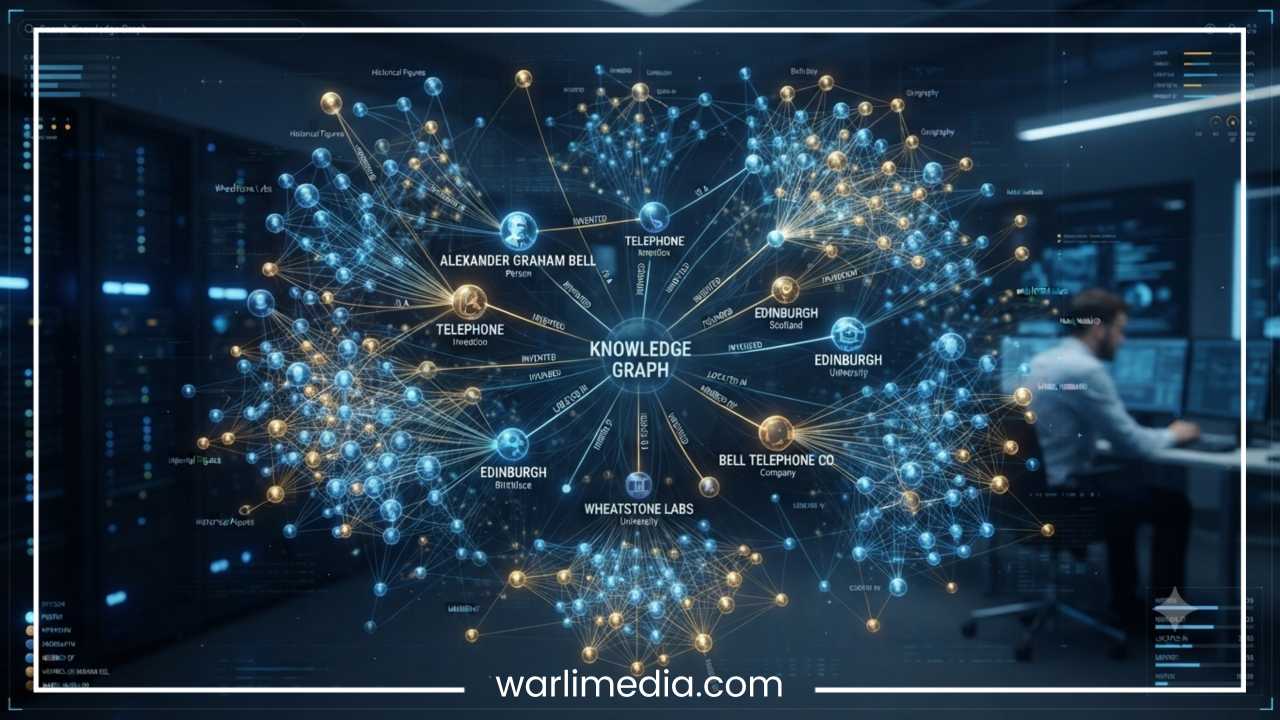
At its core, a knowledge graph is a programmatic, structured representation of information that models the real world as a network of interconnected entities. Unlike traditional databases that store information in flat tables, rows, and columns, a knowledge graph treats the connections between data points as first-class citizens. This approach allows machines to comprehend the semantic meaning behind data, rather than just processing strings of characters.
To understand how a knowledge graph functions, it is helpful to break it down into three core structural elements:
Entities: These represent the foundational building blocks or “things” in the graph. An entity can be a person, a company, a physical location, a product, or even an abstract concept.
Relationships: These are the directed links that connect one entity to another, defining how they interact or relate to each other.
Attributes: These describe the specific properties or characteristics of an entity, adding granular detail to the nodes.
Consider a practical example of how a knowledge graph structures information:
The entity Elon Musk is linked via the relationship “founded” to the entity SpaceX. In turn, SpaceX is linked via the relationship “develops” to the entity Rockets, which is connected via the relationship “use” to the entity Engines.
By representing knowledge as an ongoing network rather than a series of disconnected rows, systems can navigate through complex pathways of information effortlessly. To dive deeper into this architecture, it is essential to familiarize yourself with several key technical terms:
Nodes: The visual and structural points in a graph that represent entities or attributes.
Edges: The lines or links that connect nodes, representing the specific relationships between them.
Triples: The foundational semantic unit used to store data in a knowledge graph. A triple follows a strict format: Subject – Predicate – Object (for example, SpaceX [Subject] – develops [Predicate] – Rockets [Object]).
Ontologies: The formal frameworks and rules that define the categories, properties, and relationships allowed within the graph.
Semantics: The study of meaning. In data science, semantic systems ensure that computers understand the specific meaning of words based on their context within the network.
Read: How to Do a Website Audit to Elevate SEO and UX
How Does a Knowledge Graph Work?
Building and operating a knowledge graph is a multi-stage pipeline. The process involves ingesting raw data, extracting meaning, discovering underlying connections, and organizing the resulting network into a standardized semantic format that machines can query.
Data Collection
The journey begins with data collection. Knowledge graphs are highly versatile because they can ingest data from an incredibly diverse array of sources. These sources include structured enterprise databases, unstructured websites, text documents, PDF files, public application programming interfaces (APIs), internet of things (IoT) device sensors, and internal enterprise systems like customer relationship management (CRM) platforms. By gathering data across these distinct landscapes, the graph prepares to break down institutional silos.
Entity Extraction
Once the raw data is collected, the system undergoes entity extraction, a process heavily reliant on Natural Language Processing (NLP). During this phase, the system scans text and data streams to identify specific people, organizations, products, locations, and events.
For instance, consider the sentence: “Apple released the iPhone in 2007.” An entity extraction engine analyzes this text and identifies three distinct elements: “Apple” is classified as a Company, “iPhone” is classified as a Product, and “2007” is classified as a Date.
Relationship Discovery
Identifying individual entities is only half the battle; the system must also discover how they relate to one another. Relationship discovery uses machine learning and NLP algorithms to analyze the syntactic structure of sentences and data patterns to identify connections.
Through relationship discovery, the system establishes explicit links such as: a Person “works for” a Company, a Product “belongs to” a Category, or a specific Disease “is treated by” a Medicine. This transforms isolated terms into dynamic statements of fact.
Knowledge Representation
The final phase of the workflow is knowledge representation. Once entities and relationships are extracted, they must be formatted using standardized frameworks so that software applications can read and reason over them. This is achieved using:
Resource Description Framework (RDF): A standard metadata model used to model information as triples.
Graph Databases: Specialized storage engines optimized to execute queries across millions of interconnected nodes and edges instantly.
Ontologies and Semantic Models: The overarching blueprints that govern the logic of the graph, ensuring that data points remain consistent, accurate, and logically sound across the entire enterprise.
Read: Canonical Tags: A Beginner’s Guide to SEO Success
Key Components of a Knowledge Graph
To fully appreciate the architectural elegance of a knowledge graph, we must dissect its four primary components: nodes, edges, properties, and ontologies.
Nodes (Entities)
Nodes represent the distinct entities within the graph ecosystem. Every node corresponds to a real-world object, individual, or abstract idea, such as a specific Person, Organization, Product, Location, or Event.
A critical function of nodes within a knowledge graph is managing entity identity. In the human language, words often have multiple meanings depending on context. A traditional keyword search might confuse the technology company “Apple” with the fruit “apple.” A knowledge graph prevents this by assigning a unique resource identifier (URI) to each node. This ensures that the system explicitly distinguishes between the multinational corporation and the agricultural product, maintaining complete data integrity.
Edges (Relationships)
Edges are the directed connections linking the nodes. They define the type, direction, and semantic meaning of the relationship between two entities. Edges are not merely passive lines; they carry explicit meaning that dictates how the system reasons about the data.
For example, an edge might specify that an entity “is located in” a specific city, was “created by” a particular author, or exists as a “part of” a larger mechanical assembly. Because edges are directional, they establish clear hierarchies and dependencies, allowing applications to trace paths from one entity to another across vast distances within the network.
Properties and Attributes
While nodes and edges establish the network structure, properties and attributes fill in the vital details. Properties are key-value pairs assigned directly to nodes or edges to describe their specific characteristics.
For a Person node, the attributes might include their full Name, Date of Birth, and Occupation. For a Company node, the properties might include its Industry vertical, Headquarters address, and Founder name. This allows a knowledge graph to combine the structural benefits of network topologies with the granular descriptive capabilities of traditional records.
Ontologies
An ontology is the conceptual backbone of a knowledge graph. It represents the formal set of rules, taxonomies, and definitions that organize the knowledge base. Without an ontology, a knowledge graph would be a chaotic web of arbitrary labels. The ontology provides the schema, teaching the machine how different categories of things relate to one another logically.
For example, an ontology might dictate an organizational hierarchy for living things:
An Animal category contains a sub-category called Mammal. The Mammal category further splits into specific sub-categories like Dog and Cat. Because the machine understands this hierarchical taxonomy, it can automatically infer that if a specific node is a “Dog,” it must also inherit the characteristics of a “Mammal” and an “Animal.” This capacity for logical inference is what makes knowledge graphs uniquely powerful.
Knowledge Graph vs Traditional Database
Organizations often wonder why they should implement a knowledge graph when they already have robust traditional relational database management systems (RDBMS). The answer lies in the fundamental difference between how these two systems handle architecture and relationships.
| Traditional Database | Knowledge Graph |
| Stores information in rigid, isolated records | Stores information as a network of relationships |
| Utilizes a strict, pre-defined fixed schema | Utilizes a highly flexible, evolving graph structure |
| Optimized for high-volume transactions | Optimized for complex data discovery and insights |
| Provides limited contextual understanding | Provides rich, multi-layered semantic meaning |
Relational databases organize data into rigid tables where relationships are established using foreign keys. When you want to query connections across multiple tables in a traditional database, the system must perform highly resource-intensive “JOIN” operations. As the complexity and depth of your questions grow, the performance of an RDBMS degrades drastically.
Knowledge graphs, by contrast, store relationships directly alongside the entities. Traversing connections requires no computationally expensive joins; the system simply follows the established edges from node to node.
Choosing the right tool depends entirely on the operational use case. For executing standard banking transactions—such as processing a deposit or updating an account balance—a traditional database is the ideal choice due to its structured predictability. However, if an organization wants to build a customer relationship intelligence platform that maps out every interaction, shared connection, and historical preference of a client, a knowledge graph is far superior.
Knowledge Graph vs Knowledge Base vs Database
The terms database, knowledge base, and knowledge graph are frequently used interchangeably in technology discussions, yet they represent distinct concepts with varying levels of sophistication.
Database
A database is the most fundamental layer of data storage. It is designed to store raw, structured or semi-structured information efficiently. It focuses primarily on data persistence, security, and rapid retrieval of isolated records. A database does not inherently understand the meaning of the records it holds; it simply stores them as instructed by the application layer.
Knowledge Base
A knowledge base is a curated collection of information used primarily for answering questions, troubleshooting, and self-service information retrieval. A common example is a company’s internal help desk documentation or an online FAQ portal. While a knowledge base contains valuable, high-level informational content, it is often designed for human consumption and lacks the formal machine-readable connections that allow algorithms to perform automated reasoning.
Knowledge Graph
A knowledge graph represents the evolution of these concepts. It is a knowledge base organized as a highly structured network of interconnected entities and relationships. By layering an ontology over the data, a knowledge graph takes the raw information found in a database and the helpful context found in a knowledge base, transforming them into a unified, machine-understandable digital twin of real-world knowledge.
Types of Knowledge Graphs
Knowledge graphs can be broadly categorized into three distinct types based on their deployment scope, access models, and target audience: enterprise, public, and domain-specific knowledge graphs.
Enterprise Knowledge Graphs
Enterprise knowledge graphs are private networks built by corporations to unify their internal information ecosystems. Large organizations routinely struggle with fragmented data spread across distinct departments, cloud platforms, and legacy software systems. An enterprise knowledge graph serves as a single source of truth, connecting internal text documents, employee profiles, customer interaction histories, product catalogs, and corporate processes.
Two prominent use cases for enterprise knowledge graphs include:
Customer 360: Aggregating data from sales, support, marketing, and product usage to create a complete, interconnected view of every customer’s journey.
Data Governance: Mapping out corporate data lineage to show exactly where data originates, who owns it, how it moves through the company, and whether it complies with regulatory standards.
Public Knowledge Graphs
Public knowledge graphs are large-scale, open-source or publicly accessible repositories designed to catalogue general world knowledge. These graphs are maintained by global technology companies, academic institutions, and collaborative open communities to advance global research and web discovery.
Prominent knowledge graph examples include:
Google Knowledge Graph: The massive underlying engine that powers Google’s search infrastructure, serving up instant fact boxes and structured side panels when users search for notable figures, locations, or media.
Wikidata: A collaborative, multilingual secondary database operated by the Wikimedia Foundation that provides structured, machine-readable data to support Wikipedia and thousands of external AI applications.
Public knowledge graphs are highly instrumental in powering semantic search engines, global question-answering systems, and open-world information discovery tools.
Domain-Specific Knowledge Graphs
Domain-specific knowledge graphs are tailored precisely to the unique vocabulary, rules, and operational requirements of a specialized industry. General-purpose knowledge graphs lack the depth required to solve highly technical problems in niche fields, prompting organizations to build custom semantic networks.
Key industries utilizing domain-specific graphs include:
Healthcare: Mapping out complex medical terminologies, genomic data, and clinical pathways.
Finance: Tracking global corporate ownership structures, regulatory filings, and market transactions.
Manufacturing: Modeling intricate product bills of materials, asset dependencies, and global supply chain logistics.
Legal: Connecting statues, historical case precedents, judicial rulings, and regulatory frameworks.
Real-World Applications of Knowledge Graphs
The practical applications of knowledge graphs span virtually every modern industry, serving as the hidden engine behind the digital experiences we rely on daily.
Search Engines
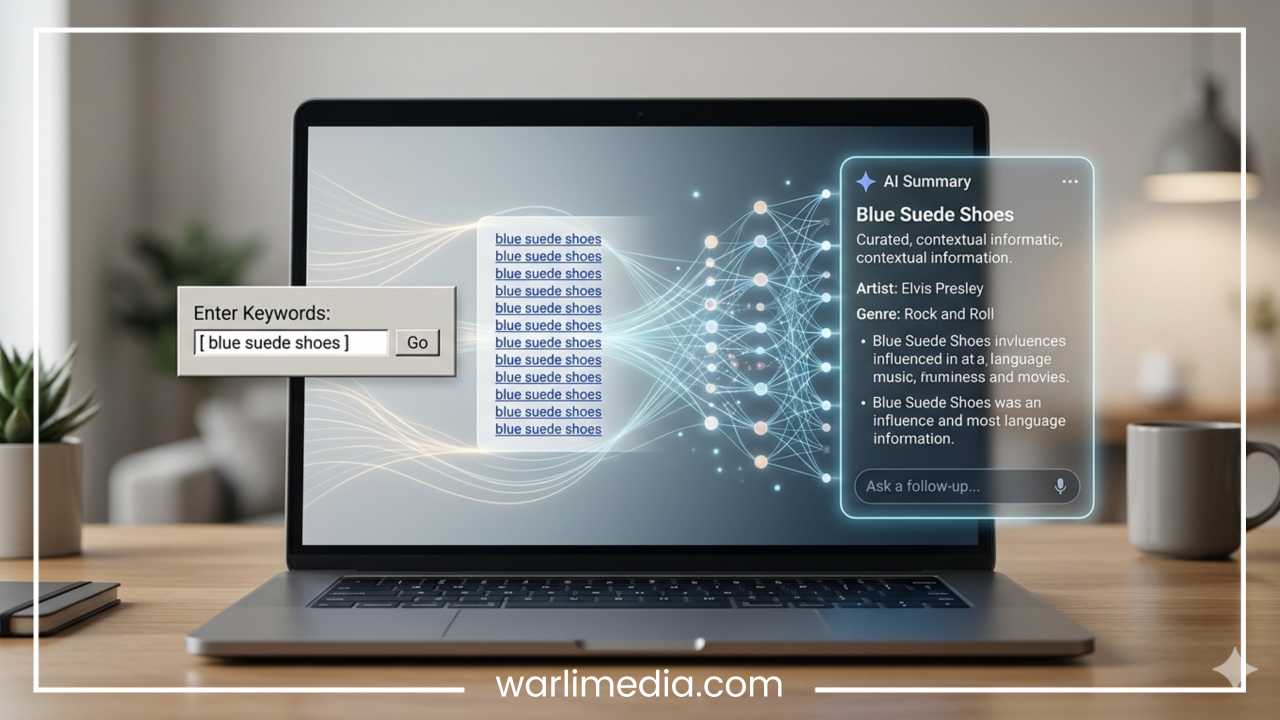
The integration of knowledge graphs revolutionized modern web search. In the early days of the internet, search engines operated via simple string matching; if you typed a query, the engine looked for documents containing those exact characters.
With a knowledge graph, search engines transition from string matching to thing matching. The system explicitly recognizes entities within the search query.
For example, when a user enters the query: “Who directed the movie Titanic?” the search engine does not just look for web pages containing those words. It parses the query, identifies the entity Movie (Titanic) and the relationship Director, and navigates the graph to instantly return the exact answer node: James Cameron. This capability enables modern search engines to provide direct answer boxes and interactive rich cards, bypassing the need for users to click through multiple links.
Artificial Intelligence and Generative AI
One of the most rapidly growing areas of innovation is the intersection of the knowledge graph in AI and generative AI workflows. While Large Language Models (LLMs) display impressive linguistic capabilities, they suffer from a well-documented flaw: hallucinations. Because LLMs generate responses based on statistical word probabilities rather than a foundational understanding of factual truth, they can confidently invent incorrect answers.
Knowledge graphs serve as the ultimate antidote to this issue when paired with Retrieval-Augmented Generation (RAG). Instead of allowing an AI model to search through text documents blindly or rely solely on its static training weights, developers use knowledge graphs to anchor the AI in structured facts.
Consider an AI customer support bot navigating an issue. Instead of guessing, the RAG system references a clear structural path:
A specific Customer is mapped to a Purchased Product, which points directly to an active Support Issue, which links explicitly to a validated Solution.
By feeding this precise graph context to the generative AI model, businesses eliminate hallucinations, ensure complete factual accuracy, and provide highly relevant, contextual answers to users.
Recommendation Systems
E-commerce giants, streaming platforms, and social media networks leverage knowledge graphs to build hyper-personalized recommendation systems. Traditional recommendation models rely on collaborative filtering, which simply recommends items based on what similar users bought or watched. While effective, this approach fails to understand why a user might like an item.
A knowledge graph enhances recommendations by mapping out structural relationships between items, attributes, and user interactions. For instance:
A User explicitly “likes” a specific Science Fiction movie. The graph indicates that this Movie “belongs to” the Science Fiction genre and “stars” a particular Actor.
By analyzing these semantic links, the recommendation engine can intelligently suggest other films starring that same actor or exploring highly related thematic sub-genres, creating a deeply personalized discovery loop.
Healthcare
In the healthcare sector, knowledge graphs are accelerating scientific breakthroughs and saving lives. By creating large-scale biomedical knowledge networks, researchers can map out intricate relationships between diseases, genetic profiles, chemical compounds, and approved pharmaceuticals.
A clinical researcher might query the graph to see how a specific Disease is treated by a certain Drug, and then analyze how that Drug interacts with other Medication. This approach allows pharmaceutical companies to accelerate drug discovery by identifying existing, approved medications that could be repurposed to treat entirely different medical conditions based on shared genetic pathways.
Business Intelligence
Modern corporations utilize knowledge graphs within business intelligence to uncover hidden patterns that traditional dashboard tools miss. In fraud detection, for instance, financial institutions use graphs to analyze transactions, shared bank accounts, phone numbers, and physical addresses. If multiple accounts are linked through a web of suspicious, indirect connections, the graph highlights these anomalies immediately, allowing compliance teams to stop financial crimes before they escalate.
Benefits of Knowledge Graphs
Implementing a knowledge graph delivers profound competitive advantages by shifting how organizations interact with their data assets.
Better Data Integration
Large enterprises routinely suffer from fragmented data silos across isolated departments. A knowledge graph functions as a flexible fabric that unifies disparate data sources without forcing companies to execute costly, risky, and disruptive data migration projects. It harmonizes data by mapping diverse schemas to a single, unified ontology.
Improved Search
By focusing on semantic meaning rather than basic keywords, knowledge graphs dramatically enhance internal and external search functionalities. Systems can accurately interpret user intent, handle complex synonyms, provide intelligent auto-suggestions, and serve up direct, actionable answers rather than massive lists of irrelevant documents.
More Accurate AI
As organizations increasingly integrate knowledge graphs and generative AI, the graph serves as a critical guardrail for machine learning systems. It provides reliable context, enables logical reasoning, ensures auditability, and minimizes the risk of AI hallucinations by grounding models in verifiable corporate facts.
Data Discovery
Because a knowledge graph prioritizes connections, it excels at revealing hidden insights and non-obvious relationships across vast datasets. Analysts can discover unexpected links between customers, supply chains, and market trends that would remain completely invisible within flat, disconnected tabular views.
Scalability
Traditional databases are notoriously difficult to alter once their schema is established. Modifying a table structure in a large database often requires extensive downtime and application re-writes. Knowledge graphs are inherently flexible; you can add new entities, properties, and relationship types on the fly without breaking existing applications, allowing the graph to grow naturally alongside the business.
Challenges of Building Knowledge Graphs
Despite their immense power, constructing and maintaining a knowledge graph is a sophisticated technical undertaking that presents several operational challenges.
Data Quality
A knowledge graph is only as good as the information poured into it. If an organization feeds the graph incorrect information, duplicate entity records, or missing relationship data, the downstream results will be flawed. Maintaining high data quality requires robust data validation pipelines and continuous data cleansing.
Entity Resolution
Entity resolution is the process of determining whether different data records refer to the identical real-world entity. For example, an organization’s databases might contain references to “IBM,” “International Business Machines,” and “IBM Corp.”
A knowledge graph must be smart enough to recognize that these distinct strings represent the exact same corporate entity, merging them into a single node rather than creating fragmented duplicates.
Maintenance
Knowledge is not static; it changes continuously. Companies expand, leadership shifts, product specifications evolve, and new regulations emerge. A knowledge graph cannot be built once and forgotten; it requires ongoing orchestration, automated ingestion updates, and continuous monitoring to ensure it remains a true reflection of the real world.
Complexity
Building a resilient enterprise knowledge graph requires a highly diverse set of technical competencies. Organizations must bring together skilled data engineers, domain experts who understand business logic, and AI/NLP specialists capable of extracting semantic structure from raw data. Navigating this complexity requires a clear strategic roadmap and long-term organizational commitment.
Knowledge Graph Technologies and Tools
Building a modern knowledge graph relies on an established ecosystem of specialized software tools, open standards, and advanced database technologies.
Graph Databases
Unlike traditional databases, graph databases are engineered explicitly to store nodes and edges efficiently. They allow systems to traverse millions of complex connections instantly. Leading solutions include:
Neo4j: A highly popular, native graph database optimized for performance, scalability, and developer-friendly graph queries.
Amazon Neptune: A fully managed, high-performance graph database service provided by AWS that supports popular open graph standards.
Query Languages
To extract answers from a knowledge graph, developers use specialized query languages designed to navigate network topologies:
SPARQL: The standard semantic query language designed specifically to query data formatted as RDF triples across the web.
Cypher: A declarative graph query language popularized by Neo4j that uses an intuitive, visual syntax to match patterns within the data.
Data Standards
To ensure interoperability between different systems, the World Wide Web Consortium (W3C) established official data standards for building semantic webs:
Resource Description Framework (RDF): The foundational data modeling framework that breaks all information down into triples.
Web Ontology Language (OWL): A robust semantic language used to author complex, high-level ontologies and define rich relationship logic.
AI Technologies
Modern graph construction relies heavily on cutting-edge AI technologies to automate data ingestion at scale. Natural Language Processing (NLP) frameworks identify entities and relationships within raw text, while Machine Learning (ML) classification models assist with entity resolution. Additionally, Large Language Models are increasingly used to accelerate the conversion of unstructured corporate documentation into highly structured semantic graphs.
Knowledge Graphs and the Future of AI
As we look toward the future of technology, knowledge graphs are poised to play an increasingly foundational role in shaping the evolution of computing, automation, and enterprise intelligence.
AI Agents
The technology landscape is rapidly shifting from passive AI chatbots to autonomous AI agents capable of planning actions, executing workflows, and solving open-ended problems independently. To succeed, these agents require more than simple linguistic skills; they need deep contextual awareness and reliable access to factual data.
Knowledge graphs provide the perfect operating map for future AI agents, allowing them to understand the operational context of a business, reason through multi-step problems, and access reliable information without human intervention.
Enterprise AI
The race is on for companies to build comprehensive enterprise AI systems capable of acting on internal corporate data. Organizations are actively building unified semantic knowledge layers that sit directly on top of their corporate documents, business applications, and massive cloud data warehouses.
By creating this universal graph layer, businesses can ensure that any AI tool deployed across the company accesses a unified, secure, and fully contextualized single source of truth.
Semantic Search
The future of digital exploration lies entirely within advanced semantic search. Keyword matching will continue to fade into obsolescence as users expect search interfaces to deeply understand their specific intent, emotional nuances, and contextual situations. Future search engines will rely heavily on highly interconnected knowledge graphs to provide personalized, intelligent answers that blend global world facts with real-time personal or corporate context seamlessly.
Final Thoughts: The Importance of Knowledge Graphs
A knowledge graph is far more than a simple alternative to a traditional database; it represents a fundamental shift in how we organize, interpret, and leverage digital information. By connecting fragmented data points into meaningful, context-rich relationships, knowledge graphs bridge the gap between human understanding and machine computation.
They serve as the vital infrastructure powering modern web search, eliminating hallucinations in generative AI, and providing corporations with the deep business intelligence required to navigate complex global markets. As the volume of global data continues to expand exponentially, the ability to map, reason over, and understand interconnected information will separate successful intelligent enterprises from the rest. Knowledge graphs provide the definitive foundation for this intelligent future.
Frequently Asked Questions (FAQ)
What is the difference between a knowledge graph and a vector database for RAG?
While both are used to improve Retrieval-Augmented Generation (RAG), they handle data differently. A vector database converts data into numerical embeddings to find information based on mathematical similarity or concept proximity (e.g., finding text that “sounds similar”). A knowledge graph connects explicit entities through defined semantic relationships (e.g., knowing exactly who owns a company). Combining a knowledge graph with a vector database (Graph RAG) gives generative AI systems both broad conceptual intuition and precise, verifiable factual accuracy.
How do you build an enterprise knowledge graph from unstructured data?
Building an enterprise knowledge graph involves a multi-step pipeline powered by Natural Language Processing (NLP):
Ingestion: Gather unstructured data like PDFs, emails, and internal documents.
Named Entity Recognition (NER): Extract core entities such as people, products, or organizations.
Relationship Extraction: Identify how these entities connect based on the context of the text.
Entity Resolution: Clean the data by merging duplicates (e.g., identifying that “AI Corp” and “Artificial Intelligence Corporation” are the same entity).
Taxonomy Mapping: Align the extracted data with a central corporate ontology or graph database.
What are the best open source knowledge graph tools for developers?
For developers looking to build knowledge graphs without licensing fees, the top open-source and free tools include:
Graph Databases: Neo4j (Community Edition), Apache Jena, and Blazegraph.
Ontology Editors: Protégé (a widely-used free tool developed by Stanford for creating semantic rules).
Frameworks & Libraries: Python libraries like NetworkX (for network analysis) and RDFlib (for working with semantic web standards).
How does Google use its Knowledge Graph to improve semantic search results?
Google uses its Knowledge Graph to understand the searcher’s true intent instead of just matching exact keywords. When you search for an entity, Google pulls data from its billions of interconnected facts to generate the “Knowledge Panel”—the informational box that appears on the right side of the desktop search results. This allows the search engine to resolve ambiguities, understand context, and answer follow-up questions directly on the search results page.
What is the role of ontologies and taxonomies in a semantic web knowledge graph?
Taxonomies and ontologies act as the structural blueprint for a knowledge graph. A taxonomy is a simple hierarchical classification system (e.g., a “Laptop” is a type of “Computer”). An ontology is a much more complex framework that defines the rules, logic, and types of relationships allowed between different categories (e.g., a “Developer” [Person] “writes” [Relationship] “Code” [Software]). Without them, a knowledge graph would just be a chaotic cluster of data points without machine-readable logic.
Why are knowledge graphs critical for reducing hallucinations in Generative AI?
Large Language Models (LLMs) do not fundamentally understand facts; they calculate word probabilities. This causes them to “hallucinate” or invent plausible-sounding lies. A knowledge graph acts as a factual anchor. By mapping out an enterprise’s data into definitive “triples” (Subject-Predicate-Object), the graph provides a verifiable ground truth. When the AI pulls data directly from these mapped relationships, it replaces statistical guesswork with deterministic facts.